
Small-scale farmers around Mahikeng often have farming experience but lack access to formal training. A skills project at the North-West University (NWU) is helping to close this gap through accredited training that gives farmers skills they can use to improve their farms and build sustainable businesses.
Twenty-nine farmers have already undergone the month-long skills development programme, offered in collaboration with the Agricultural Sector Education and Training Authority (AgriSETA). They received their certificates at a ceremony that the School of Agricultural Sciences hosted at Molelwane Farm on 21 August 2026.
Created to give farmers access to accredited training, the programme is also aimed at helping them move from small-scale production towards sustainable farming businesses.
The training, held in June 2026 at Molelwane Farm, consisted of seven courses carrying 36 credits. Farmers were trained in sustainable farming, soil and plant nutrition, natural resource conservation, animal nutrition and plant development. Reading, writing and communication skills were also covered.
“The programme was designed to equip farmers not only with technical agricultural skills, but also with communication and sustainability skills that can help them operate viable farming enterprises,” said the project leader, Dr Nkele Dorcus Malahlela-Kgasago, a senior lecturer in agricultural economics at the NWU.
Lessons were given in the classroom and on the farm. This allowed farmers to put what they had learnt into practice. The training was assessed against AgriSETA standards, so farmers received recognised credits rather than only certificates of attendance.
Strong demand among farmers
The initial aim was to train 20 farmers. However, 32 farmers joined and 29 completed the programme. Farmers were recruited with the support of the African Farmers Association of South Africa (AFASA).
Farmer representative Leshabe Maria Katisi said the group included young and older farmers. Despite their different levels of experience, they shared the same goal: to improve their farms and support their communities.
“We return to our respective farms not just as labourers of the soil, but as informed stewards of the environment and capable managers of our agribusinesses,” said Leshabe. “We now possess the skills to increase our yields sustainably, protect our soil and market our enterprises effectively.”
The farmers had also learnt how farming affects the environment, she said. They were taught how to use farming methods that protect natural resources. Communication training helped them learn how to market their produce in writing and through direct communication.
Several partners supported the project. AgriSETA funded the training and provided the accreditation standards. Monageng Projects, a Mahikeng-based company, supported the training and assessment. AFASA helped connect the project with farmers and the NWU provided Molelwane Farm, transport, refreshments and academic support. Final-year students also took part in the training activities.
Farmers concerned about access to water
Water access emerged as a concern during the training. Farmers said water rights were affecting their ability to farm and apply for grants. The Department of Water and Sanitation was then invited to explain water rights and water use.
“The water rights component was not part of the initial plan. It came from listening to the farmers and responding to a challenge they identified during the training,” said Dr Malahlela-Kgasago.
The project has also created a possible route into higher education for younger farmers through its credit-bearing training. It shows how university resources can be used to respond to the needs of farmers while building skills that can support their livelihoods.
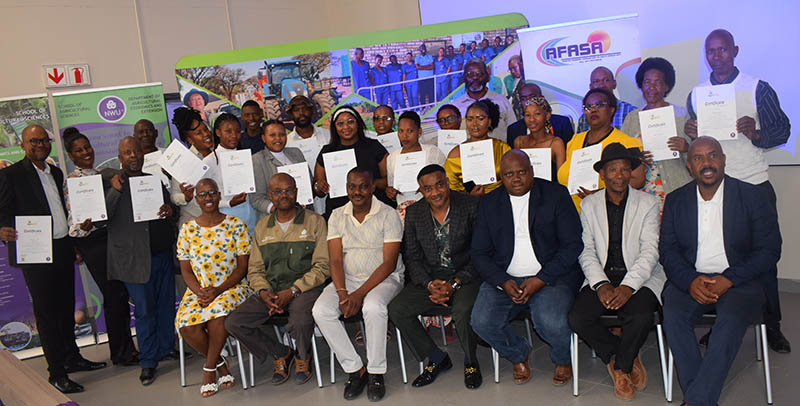
These 29 farmers completed the month-long skills development programme.


