
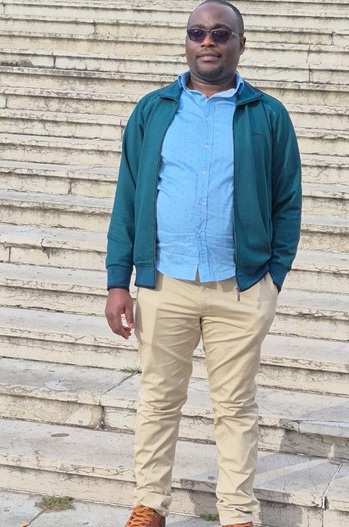
North-West University (NWU) academic Prof Patrick Tchepmo Djomegni, Associate Professor in Applied Mathematics has added an important scholarly contribution to the field of applied mathematics with the completion of his new book on mathematical modelling techniques, a project that reflects both academic excellence and deep personal meaning. Rooted in rigorous scholarship, the work honours the intellectual legacy of the late Norwegian mathematician Professor Harald Krogstad, author of Mathematical Modelling Techniques and a collaborator in postgraduate mathematics training initiatives between Ethiopia and international partners.
Reflecting on his academic journey, he says: “I have worked in Ethiopia and have been supporting postgraduate programmes in Applied Mathematics since 2017. I was also involved in a collaborative project between Ethiopia and Norway aimed at training PhD students in Mathematics. Following the passing of Professor Harald Krogstad in 2020, I was invited by Prof Mohammed Dawed, his former PhD student and, at the time, Head of the Department of Mathematics at Hawassa University to assume responsibility for and lead the project.” The project also reflects his dedication to preserving Prof Krogstad’s legacy of clarity, intellectual generosity and methodological rigour.
Mathematical modelling, often perceived as complex or abstract, is presented in the book as a powerful tool for understanding real-world challenges. From traffic systems and weather prediction to healthcare planning and the spread of diseases, modelling helps translate complex phenomena into structured frameworks that inform decision-making. Prof Djomegni emphasises that modelling is less about memorising formulas and more about asking meaningful questions, identifying patterns and applying logical reasoning to solve real problems a perspective that makes the discipline more accessible to students across diverse backgrounds.
He adds, “A defining strength of the book is its careful balance between theoretical depth and practical application. By grounding advanced concepts in real-world examples, the work encourages students to think critically and engage creatively with complex systems. Readers are equipped to move confidently between abstraction and application, developing models that are mathematically sound while remaining contextually relevant; an approach that reflects an emphasis on research that bridges theory with practical impact.”
The book also highlights the future of interdisciplinary science, demonstrating how mathematical modelling serves as a shared language across fields such as
epidemiology, engineering, economics and environmental science. Prof Djomegni believes this collaborative potential is essential for addressing today’s most pressing global challenges; an outlook that aligns with NWU’s strategic focus on interdisciplinary research and innovation.
Prof. Djomegni says, “Importantly, the text speaks directly to students and researchers in Africa and other emerging academic environments. By combining strong theoretical foundations with adaptable analytical tools, it empowers scholars to apply modelling techniques to local challenges while contributing to global scientific discourse. The work promotes a form of mathematical literacy that is both internationally relevant and locally responsive, preparing graduates to drive evidence-based solutions within their communities.”
Above all, Prof. Djomegni hopes the book will inspire confidence. His message to students intimidated by advanced mathematics is simple yet powerful: fear often comes from unfamiliarity, not inability. Through curiosity, critical thinking and persistence, learners can transform complex concepts into intuitive tools for understanding the world. For Prof. Djomeni, completing the book represents more than an academic milestone. He describes it as a testament to perseverance , inspiration and strength drawn from the Almighty God, whom he credits for sustaining the journey from years of lecrure material to a coherent and comprehensive text
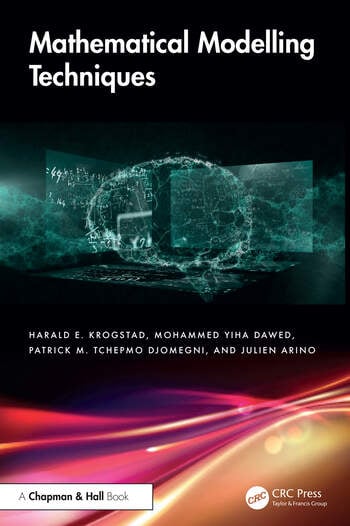
The book


