
The role of nuclear science in energy security, skills development and national partnerships took centre stage when the North-West University (NWU) hosted its Nuclear Alumni Engagement in Sandton, bringing together graduates, industry leaders, government representatives and academics to strengthen collaboration in the sector.
The engagement, held on 19 March 2026 at the Seven Villa Hotel and Spa, formed part of an alumni reunion aimed at strengthening professional networks, promoting discussion on nuclear development in South Africa, and exploring mentorship and partnership opportunities linked to nuclear studies at the university.
Delivering the welcome address, NWU principal and vice-chancellor, Prof. Mzubanzi Bismark Tyobeka, said the global demand for reliable energy continues to position nuclear power as a key component of modern energy systems, particularly as countries seek stability in electricity supply.
“Nuclear science and engineering remain central to the future of global energy security, technological advancement, and sustainable development,” he said.
Prof. Tyobeka said South Africa remains the only African country operating a commercial nuclear power station, placing the country in a position to contribute to future nuclear development on the continent.
He said universities play a critical role in sustaining the nuclear sector by training specialists, supporting research and building partnerships with government and industry. He noted that NWU graduates are working across the nuclear value chain in organisations such as Eskom, South African Nuclear Energy Corporation (NECSA), regulatory authorities and research institutions.
“This engagement represents more than an alumni gathering. It strengthens a professional network that can advance mentorship, collaboration and innovation in the nuclear field,” he said.
The reunion also focused on encouraging alumni to support current students through mentorship, contribute to programme development, and help position the university as a partner in national and international nuclear initiatives.
Speaking during the engagement, chief director for nuclear safety and technology at the Department of Electricity and Energy, Katse Maphoto, said the success of South Africa’s nuclear programme depends on coordination between government, industry and universities.
He said the country’s nuclear expansion plans require strong partnerships and long-term skills development to support the full value chain.
“A skills development strategy is required to support the nuclear programme across the value chain, including engineering design, licensing, manufacturing, construction, maintenance and operation,” he said.
Katse also noted that only a limited number of higher education institutions currently offer postgraduate nuclear-related training, and that the absence of undergraduate programmes creates a gap in the education system.
“The nuclear programme offers an opportunity for universities to introduce undergraduate specialisation in nuclear engineering and strengthen nuclear physics training to close the skills gap,” he said.
Eskom group executive for generation, Bheki Nxumalo, said Eskom is prepared to support the development of future nuclear professionals by funding students who wish to pursue studies in nuclear science and engineering.
He also challenged universities to expand their academic offerings in the field, saying the country needs undergraduate programmes that can prepare students earlier for specialised training in nuclear-related disciplines.
The group chief executive officer of NECSA, Loyiso Tyabashe, also supported closer cooperation between industry and universities, noting that the development of nuclear skills requires sustained investment in education, training and research.
The evening concluded with a call for stronger cooperation between universities, government and industry to ensure that South Africa develops the skills, research capacity and partnerships required to support future nuclear projects.
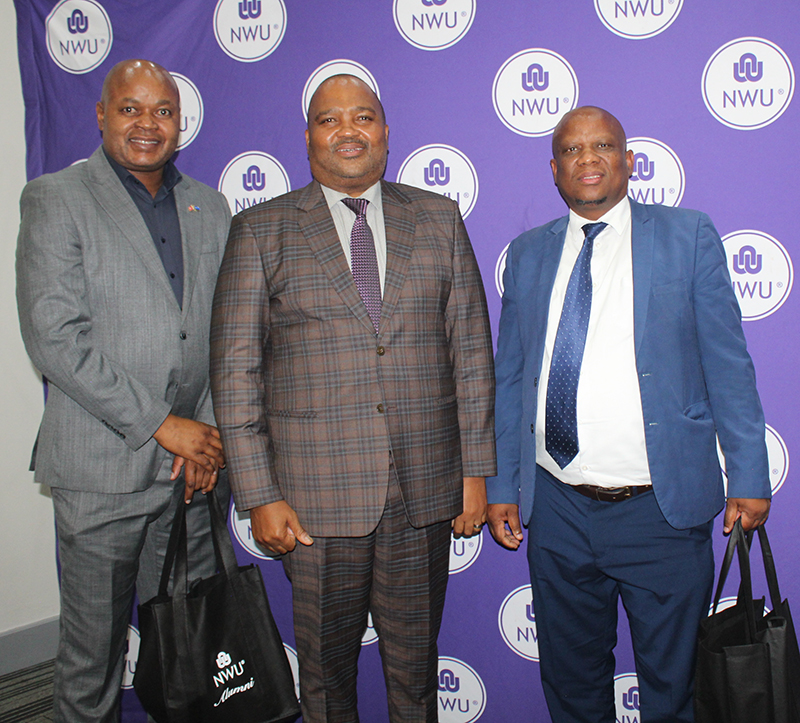
From left are Bheki Nxumalo, group executive for generation at Eskom, Prof. Bismark Tyobeka, NWU principal and vice-chancellor, and Katse Maphoto, chief director for nuclear safety and technology at the Department of Electricity and Energy.


