
South Africa’s infrastructure is failing, but the deeper crisis is that we are not developing the engineers, scientists and innovators needed to rebuild it.
South Africa boasts Africa’s leading universities, yet its basic education system remains among the world’s weakest—an alarming contradiction we can no longer ignore.
Our scientific ambitions are colliding with an education crisis, making a national reckoning on STEM education critical to the country’s future.
South Africa cannot repair its infrastructure or grow its economy using scientific and technical skills it has failed to develop.
One voice may be ignored, but 65 million voices demanding better STEM education could transform the future of South Africa.
By Prof. Bismark Tyobeka, principal and vice-chancellor of the North-West University (NWU).
I am one of 65 million South Africans. My family is part of one of 20 million households. My children are among the 21 million young people who make up one-third of our population. South Africa is my heart; this country is my home. Our voices are the shields, and our words the swords, that must protect it.
Like you, I see how our water and sanitation infrastructure continues to deteriorate, how our electricity supply remains fragile, how our roads, railways and ports are failing, and how weak municipal technical capacity and inadequate maintenance are severely affecting our quality of life.
We know who we need to fix these problems and halt the decline. However, because we think in days rather than decades, I fear our country will not have the engineers, scientists and innovators it needs when the consequences of today’s neglect finally arrive.
All the evidence points to the fact that our scientific ambitions are colliding with an education crisis.
I believe that a national debate on science, technology, engineering and mathematics (STEM) education is no longer optional; it is critical.
Recently, I read with dismay that South Africa is no longer ranked first in the Standard Bank Africa Trade Barometer. The latest rankings from the African Development Bank also show that we are no longer the most industrialised economy in Africa. We may think of ourselves as the continent’s powerhouse, but our load-shedding of expertise is proving fatal.
It is time to stop obfuscating the truth. We are only lying to ourselves and, most grievously, leading our young people down paths that will have disastrous consequences for both them and the country.
Let us look a little deeper.
A few years ago, the 2021 Progress in International Reading Literacy Study (PIRLS) showed that South African Grade 4 learners achieved an average reading score of 288, compared with the PIRLS international centre point of 500. South Africa was the lowest-performing participating country. Its score declined from 320 in 2016 to 288 in 2021. Only 19% of Grade 4 learners reached the low international benchmark; 81% did not.
The 2023 Trends in International Mathematics and Science Study (TIMSS) showed that South Africa was among the lowest-performing education systems at primary-school level. At lower-secondary level, it remained close to the bottom. The Grade 9 mathematics score improved from 389 in 2019 to 397 in 2023, while the science score declined from 370 to 362. The improvement in mathematics is real, but the score remains below the TIMSS low international benchmark of 400. There is, however, a caveat: South Africa tested Grade 5 and Grade 9 learners, whereas most participating countries tested Grade 4 and Grade 8 learners respectively.
This is where the picture becomes somewhat contradictory.
South Africa devoted approximately 6% of its GDP to education in 2024, placing it within the internationally recommended range of 4% to 6%. By comparison, African governments spent an average of approximately 3.7% of GDP on education in 2021.
South Africa also has Africa’s strongest concentration of internationally prominent universities. The QS Sub-Saharan Africa University Rankings 2026 placed South African institutions in the first seven positions, while nine of the top 10 were South African.
We are therefore an African leader in educational infrastructure, expenditure and higher education, but a continental and global laggard in the quality and equality of basic education.
This country’s universities cannot lead the charge alone. We cannot produce the engineers and scientists the country needs without a basic education pipeline that develops learners’ interest in STEM, inspires them to pursue related careers and equips them with the skills required to enrol at our institutions.
South Africa needs a complete STEM ecosystem, comprising stronger schools, better-trained teachers, capable artisans and technicians, properly funded researchers, modern infrastructure, and institutions able to convert knowledge into functioning public services. STEM education matters because South Africa cannot repair its infrastructure or grow its economy using skills it has failed to develop.
These are the facts that no comforting national myth should be allowed to obscure.
At the North-West University (NWU), we try to ignite a passion for STEM by holding an annual Vice-Chancellor’s Science Day in rural communities such as Mabeskraal, Taung, Kuruman and Wolmaransstad. There, we bring learners face to face with scientists, researchers and industry experts through engaging demonstrations, exhibitions and conversations that show them how science works, where it is applied and which STEM careers they can pursue.
I am immensely proud of this initiative, but I know it is not enough. South Africa needs an honest national reckoning about what it teaches, how it teaches it, and whether its education system is capable of producing the scientific and technical skills required for the country it says it wants to become. We must commit to a national debate in which government, schools, universities, organised labour, businesses, professional bodies and communities all participate.
This inclination to lie to ourselves must end here and now. We must demand action, action that commits us to better-trained STEM teachers, functioning laboratories, stronger technical pathways, school–university partnerships and transparent national learning targets.
We must set measurable targets, assign responsibilities, create realistic deadlines and ensure public reporting. Decades of growth and improvement depend on what we do now.
Will the right people listen? My voice is one of 65 million. So is yours. They will find it difficult to ignore 65 million voices.
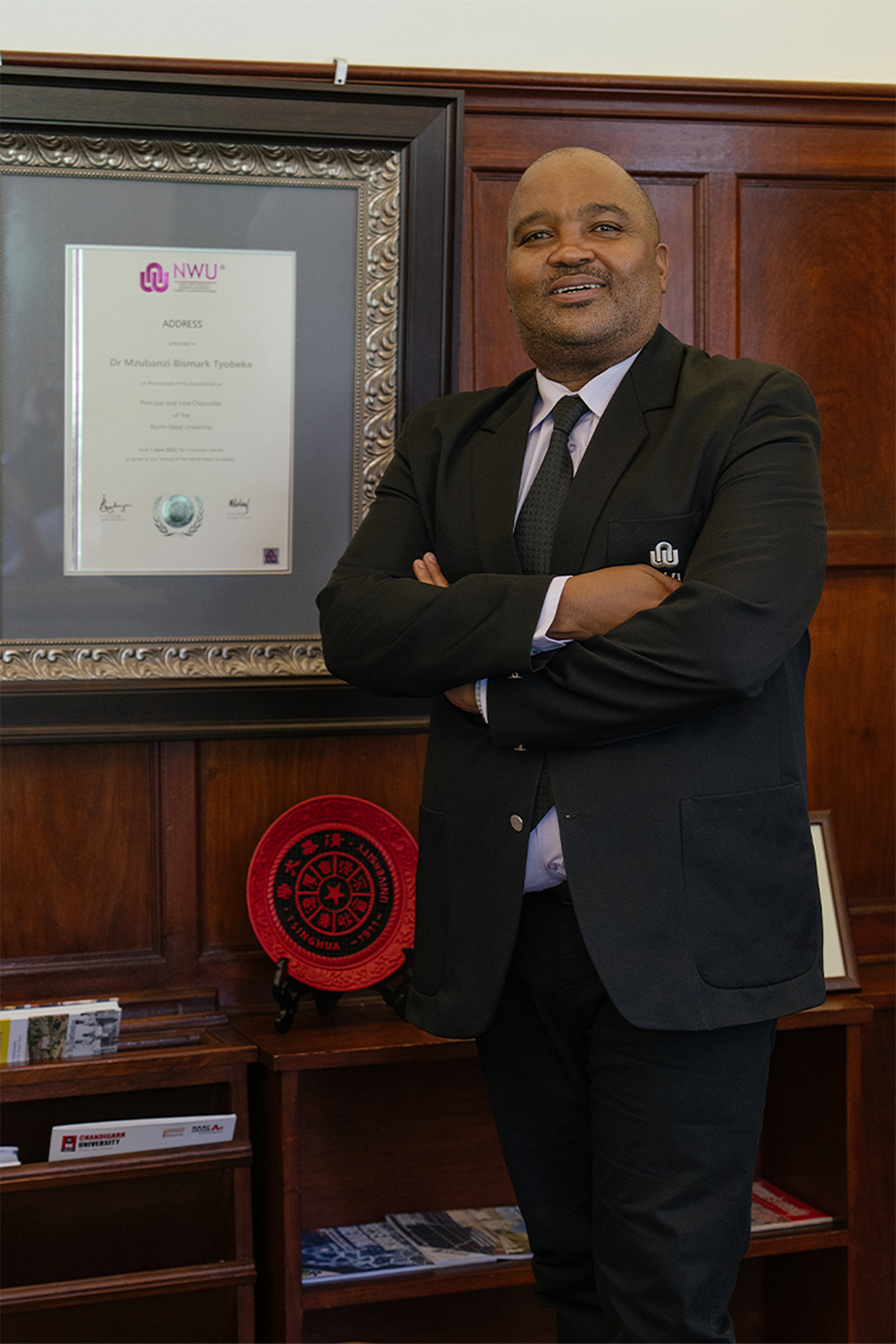
Prof. Bismark Tyobeka
Click on the video below to watch Prof. Tyobeka explain why a national debate on STEM education is critical for the current and future prosperity of South Africa:


