
At the North-West University (NWU), research is more than publishing, it is about transforming lives. This is the vision driving a team at the Centre for Human Metabolomics (CHM), where scientists developed a nanostar-based reagent that could revolutionise how rare diseases such as galactosemia are detected. The reagent promises significant advantages over conventional spherical gold nanoparticles, and demonstrates high sensitivity detection in biosensors, colorimetric assays, surface-enhanced Raman spectroscopy (SERS) and molecular diagnostics.
Under the guidance and mentorship of Prof. Chris Voster, the CHM director of the Ngwe Programme, Dr Lungani Mthembu, with support from Dr Sithi Mgidlana and student intern Victoria Khoarai, have taken their work beyond the lab, driven by the belief that science must directly impact communities. The CHM team has optimised synthesis of the nanostars in the CHM laboratories and are functionalising the nanostars to develop a point-of-care device that can bring value by solving the time delays in the detection of galactosemia, a rare metabolic disorder that affects the ability of the body to process galactose (a sugar found in dairy products and breast milk) and can be life-threatening if not diagnosed early.
For the researchers, the motivation has always been to use science as a tool to solve real problems in society. “Our discovery of using nanostars to detect galactosemia inspired us to go further than academic publications. At the CHM, we want our science to improve the lives of South Africans,” explains Dr Mthembu. This vision has been supported by the Technology Transfer and Innovation Support (TTIS) office, which has played a central role in guiding the team through intellectual property protection, securing funding and connecting them with NWU Enterprises for professional project management. “The TTIS guided us in navigating IP protection and commercialisation while allowing us to honour our academic obligations. They have been critical in helping us move our innovation closer to market,” adds Khoarai.
The collaboration between researchers and the TTIS reflects the broader commitment of the NWU to innovation with societal impact. Prof. Chris Vorster’s primary nanotech reagent has already shown strong commercial potential, highlighting the growing strength of the NWU as a hub for impactful health technologies. As Dr Mgidlana notes, “Use the TTIS as a partner to take your innovations beyond research papers. With their guidance, your work can make a real difference in society.”
Licensing for the nanostar technology is based on proprietary know-how and technical expertise, with the NWU providing access to critical synthesis methods and application support under licence. The North-West University now invites diagnostic companies, biotech developers and investors to license this high-performance nanotech reagent. Licensing options include exclusive or non-exclusive agreements tailored to different
applications and markets, with the NWU offering collaborative support to facilitate technology transfer and seamless product integration. For partnership opportunities or enquiries, please contact the TTIS: Ms Charlotte Mashaba, Senior Specialist: Commercialisation, at charlotte.mashaba@nwu.ac.za or 018 285 2136.
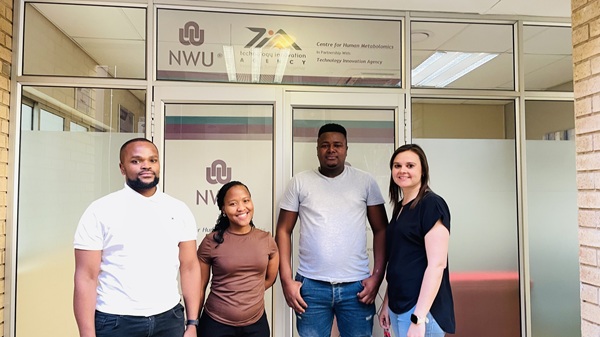
Dr Lungani Mthembu (principal investigator), Victoria Khoarai (student intern), Dr Sithi Mgidlana (post-doctoral fellow) and Prof. Ilse du Preez (acting director).


