
The Nano Environment Incubation Programme (NanoEnv) team from the Faculty of Natural and Agricultural Sciences (FNAS) at the North-West University’s (NWU’s) Mahikeng Campus engaged with the management of the Groot Marico Biosphere Reserve and local stakeholders on 20 February 2026.
The purpose of the engagement was to present scientific findings from integrated water and sediment analyses conducted at previously sampled sites within the Biosphere, and to discuss key physicochemical parameters influencing water quality in the region.
Building on a partnership established in 2022
Dr Naledi H Seheri, NanoEnv’s second project leader, said the partnership between the NWU and the Groot Marico Biosphere began in 2022 during the International Water-Climate Summer School and laid the foundation for sustained joint activities, including targeted environmental sampling across selected locations in the biosphere.
Dr Seheri emphasised that this engagement aligns closely with the NWU’s mission to bridge the gap between academic research and impact to humanity through community services. “By sharing evidence-based findings directly with local stakeholders, the university continues to position research as a tool for sustainable development and environmental stewardship,” she said.
Scientific findings on water and sediment quality
The analytical results were presented by Prof. Damian C. Onwudiwe, NanoEnv’s first project leader. He reported on the assessment of priority elements of concern in water samples, including arsenic, mercury, lead, chromium and cadmium. These elements were evaluated against the South African National Standards and international guidelines (World Health Organisation) to determine compliance and potential risk levels.
Prof. Onwudiwe also discussed the influence of climate variability and anthropogenic pressures on water systems within the biosphere. He underscored the importance of sustained, long-term water-quality monitoring to ensure early detection of potential contamination and to safeguard ecosystem and community health.
The NanoEnv team also presented a scientific poster summarising the findings to the biosphere management team, reinforcing the value of transparent knowledge-sharing between researchers and environmental managers.
Supporting community engagement through credible data
Daan van der Merwe, manager of the Groot Marico Biosphere Reserve, expressed appreciation for the robust scientific evidence generated on local water and sediment quality. He noted that the findings will strengthen the biosphere’s engagement with
surrounding communities by providing credible, research-backed information on the status of local water resources.
Such data-driven insights are critical in fostering informed dialogue around conservation, sustainable land use, and responsible water management practices.
Youth participation and citizen science in action
The NanoEnv researchers then joined the Marico Biosphere Reserve team and youth representatives for field activities. Kagiso Mogapi, chairperson of the Marico Biosphere Reserve Youth Network, and Sanna Kotsedi, project manager of the Youth Network, led practical demonstrations on river monitoring. They work closely with trained citizen scientists who play an active role in monitoring the local water resource system.
During the fieldwork session, the NWU team led the collection of additional water and sediment samples, while youth participants observed and engaged in hands-on monitoring activities. This collaborative approach not only strengthens data collection efforts but also builds environmental awareness and scientific capacity among young community members.
Advancing community-engaged research
Concluding the visit, Dr Mawethu Bilibana, a member of NanoEnv, thanked the Groot Marico Biosphere Reserve for its continued collaboration and commended the enthusiastic participation of youth members in environmental monitoring initiatives. “The partnership between NanoEnv and the Groot Marico Biosphere will continue to advance community-engaged research and promote long-term stewardship of water resources,” he said.
Through initiatives such as these, the NWU demonstrates how science, community engagement and environmental responsibility can work hand in hand to protect South Africa’s vital natural resources.
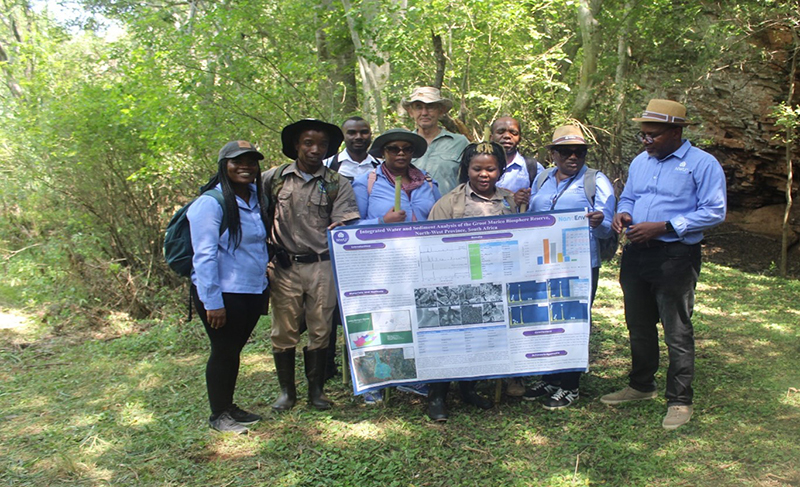
The NanoEnv team presents results on water and sediment samples and conducts sampling with the Groot Marico Biosphere Reserve and youth network.


