
Municipalities should be held accountable for failing to adopt practical innovations that could improve service delivery, reduce financial losses and help expose corruption, says Prof. Bismark Tyobeka, principal and vice-chancellor of the North-West University (NWU).
Speaking ahead of South Africa’s upcoming municipal elections, Prof. Tyobeka says artificial intelligence (AI) offers opportunities to improve municipal administration and infrastructure management. However, realising those benefits requires capable staff, functioning systems and ethical leadership.
“They need to be held accountable because, sometimes, they fail to embrace innovation for malicious reasons,” he argues.
“You do not need extensive digital capability in a municipality to adopt some practical uses of AI, such as in payroll and accounts receivable.”
Prof. Tyobeka argues that a lack of skills or capacity should not become a blanket justification for overlooking tools that could help municipalities perform these functions. In some instances, he says, resistance to innovation may serve the interests of people who benefit from inefficient systems.
“We incur costs, sometimes deliberately, because people want to benefit their friends,” he adds.
His comments place municipal willingness to improve how public money is managed and services are delivered firmly within the debate ahead of the elections.
Among the opportunities he identifies are detecting water leaks and electricity theft, monitoring payments and using predictive maintenance to help prevent infrastructure failures.
“We can use AI to detect water leaks and electricity theft,” Prof. Tyobeka explains. “We can also use AI models for predictive maintenance, so that municipalities can plan when equipment or infrastructure components need to be replaced.”
Rather than waiting for infrastructure to fail, municipalities could use these models to support maintenance schedules and anticipate when components might require attention.
However, Prof. Tyobeka cautions that AI cannot compensate for a municipality’s failure to establish the foundations of effective administration.
“AI can enable a municipality’s rescue and renewal, but you need to get the basics in place,” he says. “You need qualified people, policies and processes, the requisite computer infrastructure and access to connectivity.”
With those foundations established, AI could assist with routine administrative work, including payroll, meeting management and monitoring money owed to municipalities. It could also help identify irregularities that require investigation.
“If you do not have the basics in place, no technology can assist,” he emphasises.
Prof. Tyobeka identifies procurement as another area where AI could strengthen oversight. Tender processes involve defined steps and criteria, creating opportunities to flag bids that do not meet requirements.
“AI can be used as one of the tools to help combat municipal corruption,” he notes.
Its potential extends beyond assessing bids to examining payments, payroll records and financial reconciliations for suspicious patterns.
“Sometimes the corruption we see in municipalities involves people being paid for doing nothing – ghost employees,” Prof. Tyobeka explains. “In financial reconciliations, you can quickly pick up the outliers, and that raises questions.”
But exposing an irregularity does not guarantee that anyone will be held responsible. Prof. Tyobeka says municipal leaders must be willing to investigate what these systems reveal and act on the findings.
“You also need ethical leadership that will have the courage to question some of the things AI helps you to unearth. Otherwise, it remains a tool, and it ultimately needs a human being to take it to the finishing line.
“AI cannot deliver accountability and consequence management for you. That part must be done by the leadership,” he stresses.
He also warns that technological progress risks leaving communities behind unless South Africa addresses gaps in connectivity and education.
Rural and township schools without reliable internet access, he says, are being excluded from opportunities to develop the skills the country needs.
“We need human capacity to help us harness the power of AI. Meanwhile, that human capacity is among those we have left behind in schools without internet connectivity,” Prof. Tyobeka cautions.
For Prof. Tyobeka, building that capacity and pursuing innovation must happen together.
“The task is urgent. We need to get our basic education system in order and strengthen the pipeline through to higher education,” he urges.
As municipalities face renewed scrutiny ahead of the elections, his message is that adopting technology carries a corresponding responsibility to act: leaders must pursue practical improvements and respond when those tools expose wrongdoing.
“AI cannot deliver accountability and consequence management for you. That part must be done by the leadership,” Prof. Tyobeka concludes.
Watch the above video to hear Prof. Tyobeka explain how AI could help improve municipal services and why leaders must be held accountable for failing to embrace innovation.
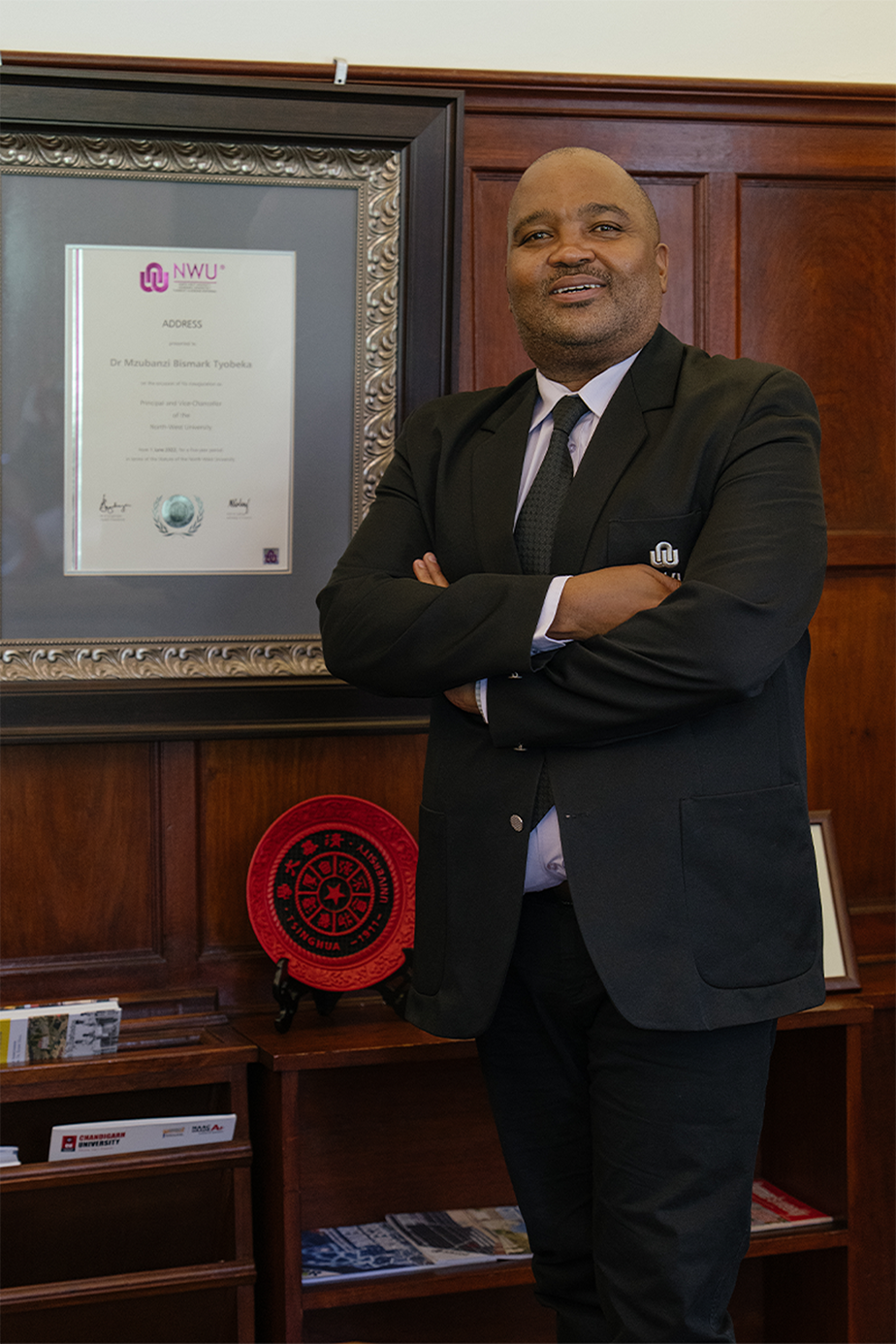
Prof. Bismark Tyobeka


