
What began as a mother’s search to help her two young sons overcome speech delays has grown into nationally recognised research that is changing how young children learn science.
Dr Moleboheng Mokhele, a senior lecturer in natural and life sciences education at the North-West University (NWU), has earned a Y2 rating from the National Research Foundation (NRF). The recognition highlights her contribution to early childhood science education and her efforts to make science more accessible through play, storytelling and digital learning.
For Dr Moleboheng, the journey began at home, where she faced a challenge familiar to many parents. Her two sons, Wavhudi and Rivhavhudi, experienced speech delays as toddlers. Drawing on her science background, she explored ways to support their language development.
She discovered that educational games helped them communicate. As their language skills improved, the boys also developed an interest in mathematics and science.
“My journey in science education began at home, and not as a research proposal,” says Dr Mokhele. This personal experience sparked a research question: Could play, pictures and storytelling help young children understand science before they enter formal schooling?
Dr Mokhele pursued this question through her PhD in natural science education, which she completed at UNISA in 2023. Her research examined how visual and digital literacy could improve science teaching in early childhood education.
Her findings led to the development of Renewable Rangers, a play-based carpet game that introduces Grade R learners to renewable energy and systems thinking.
The game features characters based on her two sons, guided by a character called “Dr Mummy Ranger”. It uses familiar stories and practical activities to help children explore scientific ideas.
The project has since expanded into Renewable Rangers Africa, a Minecraft Education learning world designed for learners from grades R to 7. A board game is also being developed.
Beyond creating learning materials, Dr Moleboheng aims to address a challenge facing early childhood education. Many teachers lack specialist training in science, technology, engineering and mathematics (STEM). This can affect their confidence when introducing scientific concepts to young learners. Her research focuses on practical teaching methods that help teachers make science enjoyable, relevant and easier to understand.
The NRF Y2 rating recognises promising early-career researchers whose work demonstrates the potential to establish them as leaders in their fields. The rating follows an independent peer-review process.
For Dr Moleboheng, the recognition reflects years of research shaped by both academic training and personal experience. Her work now covers early childhood STEM education, visual literacy, self-directed learning and the use of artificial intelligence in science education.
A distinctive feature of her research is its use of maternal autoethnography, an approach that draws on a mother’s lived experience to examine broader educational questions.
Her influence also extends beyond the university. Through postgraduate supervision, she supports students who are adapting the Renewable Rangers approach to other subjects, including history, reading and climate change education. Through her company, WARINOVA (Pty) Ltd, she aims to make these educational resources available to schools, families and communities.
Her forthcoming book, What a Mother Knows: Grounding Early Childhood STEM Education in African Contexts, explores how African parents’ and teachers’ knowledge can help shape science education.
Dr Moleboheng’s achievement shows how everyday experiences can inspire research with wider educational value. What began as a mother’s effort to help her children find their voices has become a contribution to science education that could help many more children discover theirs.
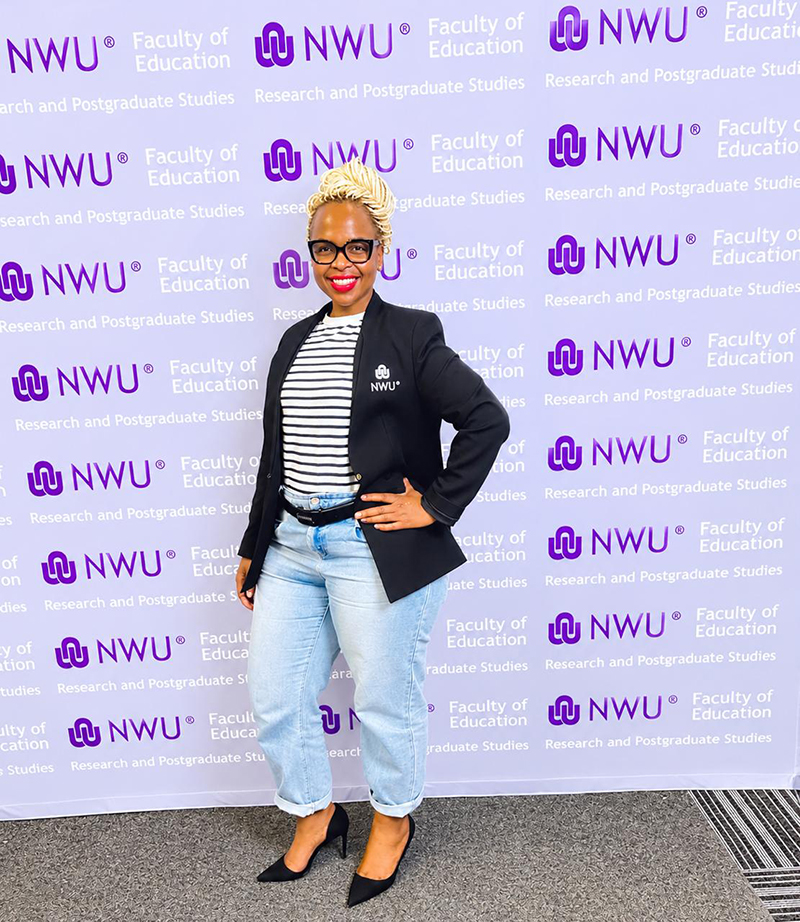
Dr Moleboheng Mokhele has received an NRF Y2 rating for her research into early childhood science education, which uses play, storytelling and digital learning to make science more accessible to young learners.


