
Strengthening ties in two fast-growing scientific fields, medicine and space science, was the central focus of high-level engagements at Otago University in New Zealand where the North-West University (NWU) explored opportunities to advance its internationalisation drive.
The visit on 28 November brought together academics working in medical training, health research and astrophysics to map out areas where their institutions can work together in coming years.
Founded in 1869, Otago University is New Zealand’s oldest institution of higher learning with more than 21 000 students across several campuses. It is ranked among the top 200 universities globally and is the only institution in New Zealand listed in the global top 20 across several subject areas. Its medical and science faculties are among its most recognised academic strengths.
At the Otago University Medical School, which admits approximately 350 medical students annually, the NWU delegation met with senior academic teams across three campuses – Dunedin, Wellington and Christchurch. In addition to its five-year programme that combines foundational medical sciences with clinical rotations, the school also conducts tuberculosis genomic research through its microbiology and immunology units.
Reflecting on the health science discussions, Prof. Luke Binu, extraordinary associate professor in the NWU’s Unit for Transdisciplinary Health Research, said the engagements created clear academic touchpoints. “Otago’s medical training structure and its research focus form a strong basis for student mobility, shared teaching and structured academic projects. These areas can support institutional growth on both sides,” he said.
In space science, the NWU’s Centre for Space Research (CSR) met with Prof. Florian Beyer, associate dean of Science for Internationalisation, and Prof. Jonathan Squire of the Astrophysical Plasmas and Fluids Group. Their discussions highlighted shared interests in cosmic-ray transport, heliospheric physics, plasma astrophysics and mathematical modelling – all areas that support long-term scientific projects and postgraduate training.
Prof. Amare Abebe Gidelew, research director at the CSR, said the meetings would contribute to shaping the NWU’s scientific direction. “Our research programmes intersect in meaningful ways. Focused postgraduate supervision and joint scientific work can strengthen both our research outputs and our student training pipeline,” he said.
Looking back on the broader tour to Australia and New Zealand by administrators and academics from the NWU, Nontsikelelo Kote-Nkomo, executive director for strategy and strategic projects at the NWU, said the visit offered key lessons for the university’s future.
“A major takeaway was how universities integrate the Aboriginal and Māori communities into their academic systems,” she said. “We were also struck by the depth of work in astrophysics and astronomy, particularly the modelling, the long-term planning and the scale of their scientific infrastructure. There is much we are bringing back. As we move into 2026, we are looking beyond memoranda of understanding and toward practical action.”
Further engagements between the NWU and Otago University are expected as the institutions examine structured research and academic opportunities.
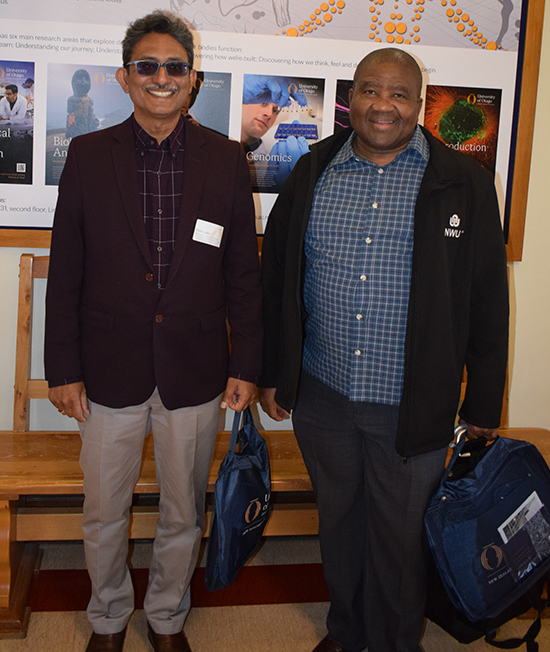
Prof Binu Luke and Prof Molekodi Matsipane from the Faculty of Health Sciences visited the Department of Anatomy at Otago University.
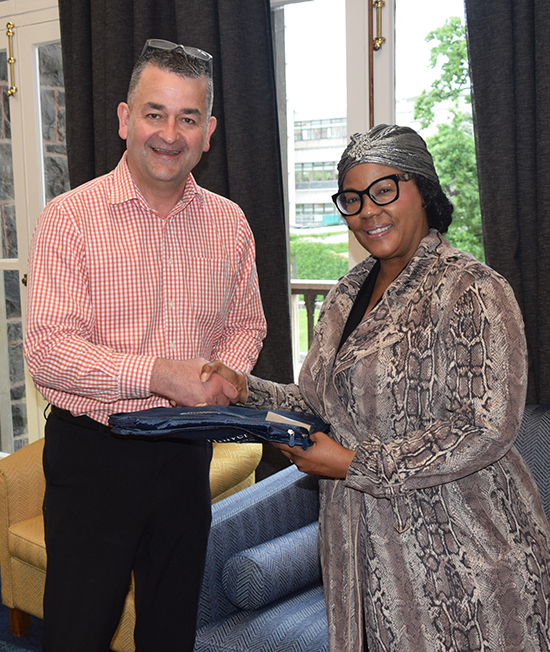
Jason Cushen, Director International at Otago University, with the head of the NWU delegation, Ntsiki Kote-Nkomo.


