
Mandisa Mazibuko is more than a North-West University (NWU) alumnus – she is a changemaker, a role model and a trailblazer in African agriculture.
Her legacy is not just in what she has achieved, but in how she is inspiring others to step into the field, plant their own seeds of purpose and grow something greater.
Her love for agriculture was cultivated long before she set foot on a university campus. Growing up in a farming community, Mandisa was introduced to livestock farming by her grandfather, a dedicated farmworker.
“Being around a farming environment and my grandfather being a farmworker exposed me to a lot of animal farming activities – from livestock branding to feeding and early mornings of manual cow milking,” she said.
But while her home life revolved around animals, Mandisa’s curiosity was rooted elsewhere. “No one around me was into crop production. Everyone at home was fixed on animals at the time,” she explained. “So, being around my grandfather when he was counting the livestock or milking cows made me realise that even though I am a woman, I can also be in the agricultural space one day – but I was more curious about plants than livestock.”
That early interest led her to the NWU, where she enrolled for a diploma in agriculture, later progressing to a BSc and currently pursuing her MSc in agronomy. Along the way, she discovered not just a field of study but a purpose – to solve real problems faced by farmers and the environment.
“Right now we are facing climate change, which results in drastic changes in weather conditions,” she said. “Our soils have deficiencies in essential nutrients, especially in areas with poor farming methods and soil erosion.”
Her research focuses on identifying maize cultivars that can thrive under different conditions – particularly in semi-arid regions like the North West, where rainfall is often scarce. “Most farmers depend on the rain, so the less rain, the lower their yields,” she said.
She is also tackling another critical challenge: the environmental impact of synthetic fertilisers. “Inorganic fertilisers can be detrimental to the environment,” she said. “They contribute to the decrease in soil microorganisms and cause imbalances that disrupt plant growth.”
To address this, her research explores the use of poultry manure – a nutrient-rich organic alternative that supports soil health, microbial activity and long-term fertility. “One might say farmers know about the use of organic manure, but my question is – do they really know the correct quantities to apply?” she asked.
Mandisa is testing various poultry manure application rates under both irrigated and dryland conditions, with the goal of making practical, evidence-based recommendations to farmers. “My research will enlighten farmers on which maize cultivars to plant based on their environmental conditions, and what poultry manure rates to apply to avoid over-fertilisation,” she said.
Her passion does not stop at the research plot. She is deeply motivated by the opportunity to tackle issues like food insecurity and soil degradation in ways that are sustainable for both people and the planet. “What is exciting is dealing with issues like food insecurity and soil degradation in a healthy way for both humans and the planet itself,” she said.
Mandisa also sees organic farming as a vital part of the solution. “Organic farming can help with the reduction of greenhouse gas emissions by avoiding the use of inorganic fertilisers and chemicals, as they produce methane,” she explained. “It also improves the soil organic matter, helps with water-holding capacity, and reduces erosion and nutrient leaching that can pollute waterways.”
She is not only thinking scientifically but socially. Her long-term vision includes launching a community-based farming project to share knowledge, promote food security and empower local farmers. “Pursuing research is important,” she said, “but I also want to focus on the practical side of agriculture to stay updated on current challenges farmers are facing – and to give back to my disadvantaged community.”
Mandisa is passionate about encouraging young women to step into the agricultural space with confidence and innovation. “Agriculture needs your innovative mindset,” she said. “Look at it as an umbrella for everyone – not just males but all humans at large. Your courage and strength to take part in this industry can change the world’s mindset on how they look at agriculture when it comes to gender.”
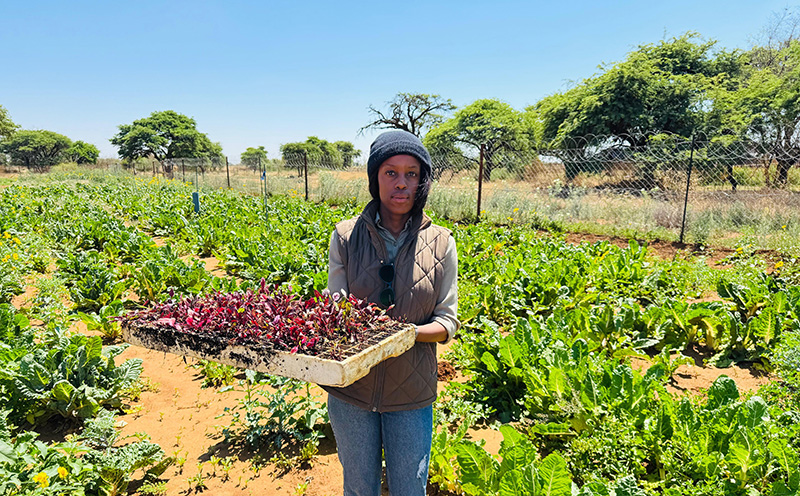
Mandisa Mazibuko is a trailblazer in African agriculture.


