
North-West University (NWU) studentpreneurs from the Mahikeng Campus have made their mark at the Leopard’s Lair pitching finals, themed “Battle of the faculties”, securing three top positions across the knowledge-based and side-hustle categories of the competition.
The achievement highlights the entrepreneurial potential of the NWU students, who are developing innovative business concepts that respond to real-world challenges, while creating opportunities for sustainable enterprises and community development.
Representing three different faculties, the students demonstrated how entrepreneurship can emerge from diverse academic disciplines, with ideas addressing agricultural innovation, youth empowerment, education and environmental sustainability.
Tshepo Mudau, a second-year BSc applied mathematics and electronics student in the Faculty of Natural and Agricultural Sciences, was named first runner-up in the knowledge-based category for his business, AgriMind AI. Samuel Khumalo, a second-year accounting student in the Faculty of Economic and Management Sciences, won the side-hustle category with Mtungwa Gaming. Shaun Tamane, a first-year master’s-degree student in political studies in the Faculty of Humanities, secured the position as first runner-up in the side-hustle category with his Eco-Interactive Learning Suite.
Harnessing artificial intelligence to support farmers
Tshepo’s business, AgriMind AI, is an agricultural technology platform designed to support South African farmers through artificial intelligence (AI) and digital services.
The platform aims to provide AI-powered farming advice, crop and livestock disease detection, weather updates, an agricultural marketplace and live livestock auctions. By connecting farmers with buyers, suppliers and agricultural experts, the business seeks to improve productivity, reduce farming losses and strengthen access to agricultural information. A key feature of AgriMind AI is its focus on communicating with farmers in their preferred languages, recognising the importance of accessible information in agricultural decision-making.
The concept demonstrates how technology can be applied to practical agricultural challenges, particularly by improving access to information and connecting farmers with services and markets.
Turning township gaming into opportunities for young people
Samuel’s Mtungwa Gaming, a subsidiary of the MTUNGWA CORPORATION, won the side-hustle category with a business concept that positions gaming as a platform for youth development and digital opportunity.
The initiative is founded on the belief that the place where a young person is born should not determine their future. It aims to establish integrated township gaming and digital opportunity centres that provide gaming services alongside educational programmes, digital skills development and youth initiatives.
Through this approach, Mtungwa Gaming seeks to create constructive spaces for young people while offering alternatives to social challenges such as gangsterism, substance abuse, violence and crime.
The business combines entertainment with broader ambitions for youth empowerment, skills development and community impact, demonstrating how a side hustle can evolve into a platform for social entrepreneurship.
Transforming waste into interactive learning tools
Shaun’s Eco-Interactive Learning Suite combines environmental sustainability with education by transforming post-consumer waste, particularly food takeaway packaging, into durable, game-based learning materials.
The concept uses interactive board games to help learners and university students engage with complex concepts through play. By repurposing discarded materials into educational resources, the initiative seeks to promote learner engagement, literacy and problem-solving while supporting the principles of a circular economy.
Motivated by concerns about the literacy challenges facing South Africa and the need for engaging approaches to learning, the project brings together waste reduction and educational innovation. It demonstrates how discarded materials can be reimagined as tools to support learning and make education more interactive.
Taking social entrepreneurship further through Enactus
Beyond their achievements at the Leopard’s Lair finals, Shaun and Samuel have also taken on leadership responsibilities in the NWU Mahikeng Enactus executive team for the 2026/27 term. Shaun has been appointed research and development officer, while Samuel will serve in the finance executive portfolio.
In these roles, they will contribute to cultivating a culture of social entrepreneurship among students and encouraging young people to develop initiatives that address challenges in their communities.
Through Enactus, they aim to help students turn entrepreneurial ideas into practical projects that can grow, create employment opportunities and improve livelihoods. Their appointments complement their achievements at the pitching competition, demonstrating a commitment to applying entrepreneurial thinking beyond the classroom and into community development.
Innovation across faculties
These three achievements reflect the diversity of ideas emerging from the Mahikeng Campus of the NWU. From applying AI to agriculture and creating digital opportunities for township youth to developing sustainable educational tools, the studentpreneurs have demonstrated how academic knowledge and entrepreneurial initiative can be translated into potential solutions.
Their success also highlights the value of encouraging students to explore entrepreneurship alongside their studies. Developing a business idea can strengthen problem-solving, communication, financial planning and innovation skills, while helping students identify opportunities to contribute to the economy and society.
In a province and country facing significant employment challenges, student-led enterprises offer one avenue through which young people can explore self-employment, develop new services and potentially create opportunities for others. Although building sustainable businesses requires continued effort, resources and market development, these achievements demonstrate the creativity and initiative that can help young entrepreneurs take their first steps.
The three studentpreneurs have shown that innovation is not confined to a single discipline. Their success at the Leopard’s Lair finals, together with their continued involvement in entrepreneurship and student leadership, celebrates the potential of the NWU students to develop ideas that respond to local needs and broader societal challenges.
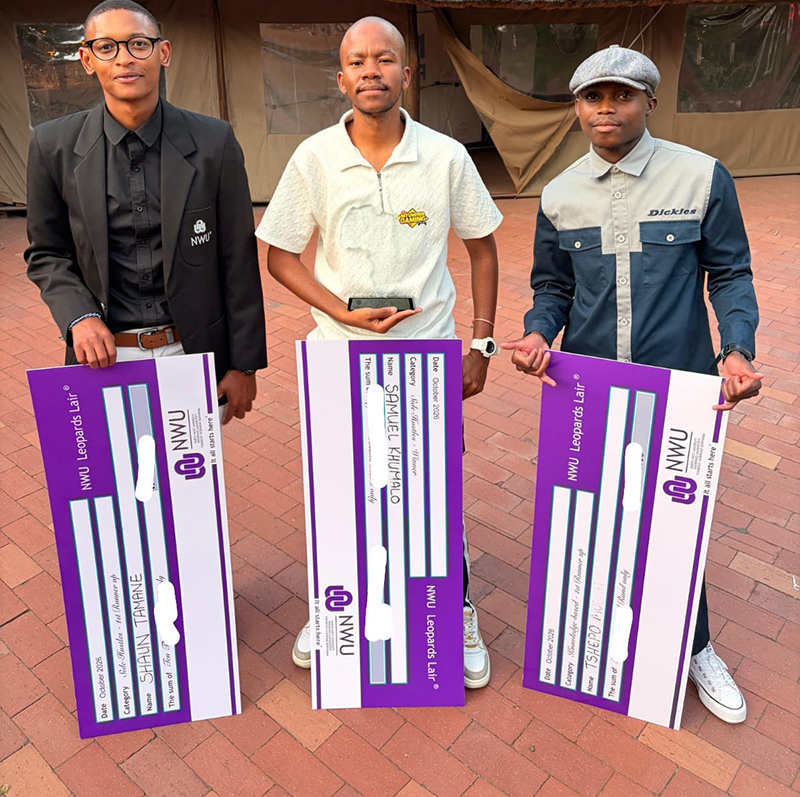
From left are Shaun Tamane, Samuel Mtungwa and Tshepo Mudau.


