
The ten-minute drive from the North-West University's (NWU) Potchefstroom Campus to Pienaarskamp, just outside the city, is not scenic in the classical sense of the word. Along the route, new shopping centres and other developments show that Potchefstroom is slowly spreading its commercial wings. Yet once you pass through the farm's gates, greeted by thriving sunflower and maize fields, it becomes clear that this is more than just a farm. It is a working laboratory where researchers, students and farmers are testing ideas that could help shape the future of food security in South Africa and beyond.
For Prof Nomali Ngobese from the NWU’s Unit for Environmental Sciences and Management in the Faculty of Natural and Agricultural Sciences, the potential of this farm is as rich as the soil she and her team are cultivating.
The scope of this endeavour spans a wide range of disciplines, but its purpose extends far beyond academia. It is a necessity.
Climate change is increasing the frequency and severity of droughts, floods and unpredictable weather patterns, while weak agricultural resilience limits farmers' ability to withstand and recover from these shocks, creating a growing threat to food security.
The NWU’s living laboratory aims to create a buffer between farmers and the dangers threatening food security.
“Pienaarskamp has evolved into an important Living Laboratory for Sustainable agriculture where research, innovation and practical farming intersect to address real-world agricultural challenges. What makes the model particularly valuable is that research findings are not confined to laboratories or academic journals. Farmers, students and community stakeholders are able to observe outcomes directly and engage with researchers. In this way, the farm becomes more than a research site; it becomes a centre for innovation, collaboration and practical agricultural transformation,” Prof. Ngobese explains.
Food security, however, is not simply about producing more food. It is about securing quality and ensuring food systems can withstand the pressures of a rapidly changing world.
According to Prof Ngobese, the NWU is contributing to food security through “an integrated research approach that connects crop production, soil health, climate resilience and supports grain production by farmers in the province”.
“Our work focuses not only on increasing agricultural productivity, but also on ensuring that farming systems remain sustainable under changing climatic and socio-economic conditions.”
That challenge is becoming increasingly urgent. Across Africa, farmers are facing rising temperatures, increasingly erratic rainfall patterns, soil degradation and growing pressure on already scarce natural resources. Producing food is no longer the only objective. Producing food sustainably, while remaining resilient to climatic shocks, has become equally important.
A major focus of the university's research is climate-resilient agriculture.
“One important area is climate-resilient crop research, particularly the identification of crops and crop varieties that can better tolerate drought, heat and erratic rainfall conditions. This includes work on ancient grains and other crops naturally adapted to African environments that may require fewer external inputs.”
The university is also investing in research on underutilised crops that have historically received little attention despite their nutritional value and ability to thrive under harsh conditions.
“These crops have significant potential to diversify food systems, improve nutrition and strengthen resilience among smallholder farmers.”
Yet while crop research remains important, Prof. Ngobese believes the foundation of long-term food security lies beneath farmers' feet.
“Healthy soils are the foundation of sustainable food systems.”
Across many parts of Africa, soil degradation, erosion and declining fertility are steadily reducing agricultural productivity. In response, researchers at the NWU are investigating conservation agriculture, regenerative farming systems and sustainable soil management practices aimed at restoring long-term productivity while protecting the environment.
Research at Pienaarskamp includes crop rotation, cover cropping, precision agriculture, water-use efficiency and will soon include livestock integration.
“These systems are being evaluated not only for yield performance, but also for economic viability, input efficiency and environmental sustainability under local farming conditions.”
For Prof. Ngobese, soil is far more than a medium in which crops grow.
“Soil is not simply a medium for crop growth; it is a living system that supports water retention, nutrient cycling, biodiversity and ecosystem stability.”
It is a reality that underpins much of the work taking place at Pienaarskamp. If food security is to be strengthened across South Africa and the continent, agricultural systems must become more resilient, more sustainable and better equipped to withstand future shocks.
Looking ahead, Prof. Ngobese believes universities have a critical role to play in making that happen.
“Universities have a critical role to play in shaping the future of African agriculture because they are uniquely positioned to generate knowledge, train future leaders and drive innovation.”
However, she argues that higher education institutions cannot afford to remain disconnected from the challenges facing society.
“They must become active partners in solving the continent's most pressing challenges, including food insecurity, climate vulnerability, unemployment and rural underdevelopment.”
Ultimately, says Prof. Ngobese, the role of institutions such as the NWU is not simply to produce graduates or publications.
“It is to contribute meaningfully to building resilient agricultural systems, sustainable communities and a more food-secure Africa.”
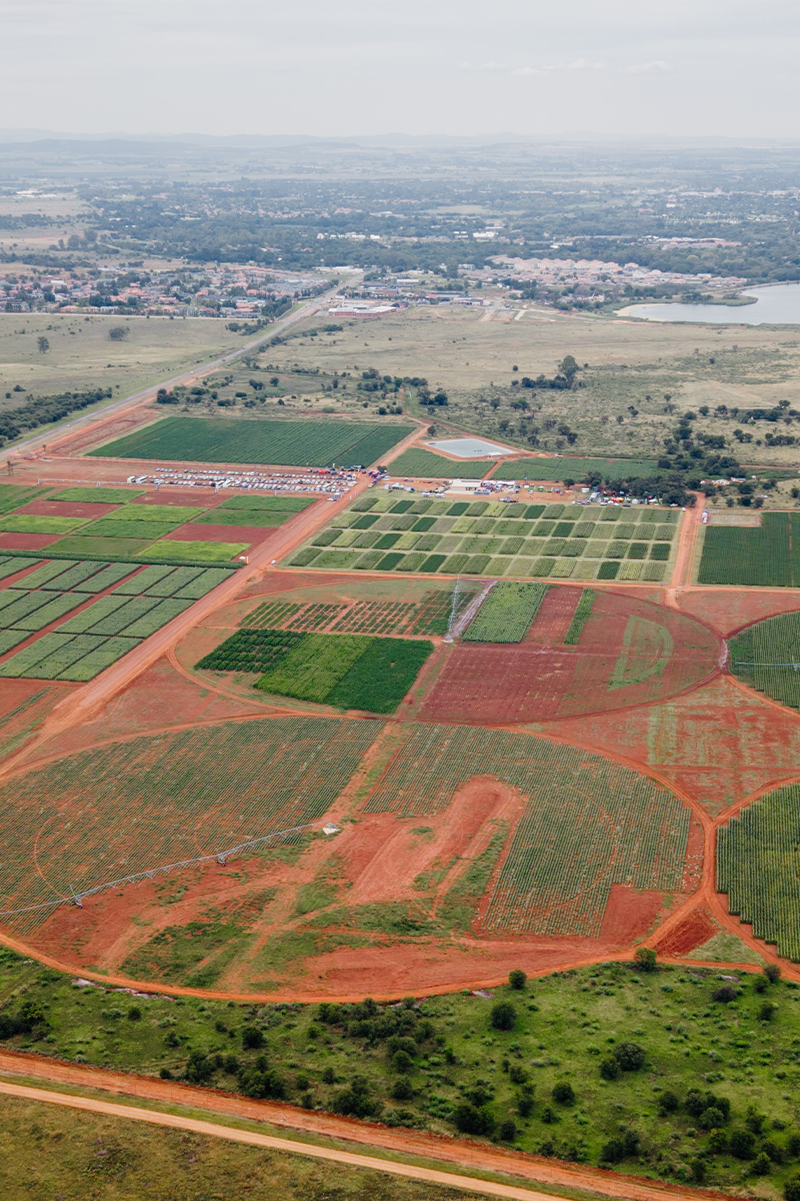
Pienaarskamp


