By Prof. Bismark Tyobeka, principal and vice-chancellor of the North-West University (NWU)
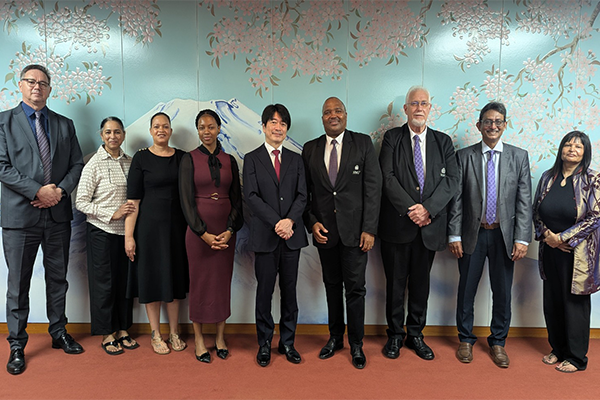
Mount Fuji’s famous peak is hidden behind a blanket of clouds today. It is a wondrous sight, and there is a serenity to it. It feels as though Japan, and specifically Tokyo, where I am, has been transported from the future to the present. The country is a technological marvel of automation and innovation, yet I also find myself carried into the past, to terrible moments more than 80 years ago.
Between 9 and 10 March 1945, flames licked the night sky red as squadrons of American B-29 Superfortresses dropped a devastating combination of high-explosive and incendiary bombs on Tokyo. Between 80 000 and 100 000 people died amid the rubble of Japan’s political and administrative heart.
On 6 August, an atomic bomb was used in warfare for the first time when it was detonated over Hiroshima. Three days later, another followed over Nagasaki. By the end of 1945, more than 200 000 people had died as a result of the two bombings.
On 15 August, Japan’s emperor, Hirohito, delivered his famous Jewel Voice Broadcast. It was the first time the Japanese people had heard his voice, but his message was one of tragedy rather than the triumph for which they had hoped.
‘We have resolved to endure the unendurable and suffer what is insufferable,’ he said, signalling Japan’s surrender.
By then, Japan had suffered catastrophic human, military and economic losses. More than two million Japanese military personnel had been killed, alongside hundreds of thousands of civilians. Around 66 major cities had been heavily bombed, much of the country’s industrial capacity had been destroyed, its merchant fleet had been decimated and its navy effectively eliminated. Food was scarce, inflation soared, transport networks were crippled and millions faced hunger. Japan had also lost its overseas empire.
Yet here I stand, in the Land of the Rising Sun, in what is now the fourth-largest economy in the world: a global leader in automobiles, electronics, robotics, machinery and advanced manufacturing, whose people enjoy among the highest life expectancies on Earth.
Then I think about the continent I call home, more than 13 000 km away. I think of our Rwenzori Mountains, with their mist-filled valleys stretching across Uganda and the Democratic Republic of the Congo, and of majestic Mount Kilimanjaro rising above Tanzania. I think of my country’s own Drakensberg, and of Mount Kenya, whose snow-capped summit stands sentinel over the continent.
Yet in the shadows of these giants, our continent has still not built industrial capacity, technological sophistication or health security on the scale achieved by this island nation of some 123 million people, occupying a landmass only slightly larger than Germany.
Why is that?
Perhaps part of the answer lies in where we choose to direct our gaze. Africa has every right to remember its past. Colonialism, slavery, apartheid, exploitation and conflict left wounds that did not disappear when flags changed and constitutions were signed. History matters because its consequences endure. But history should explain our circumstances; it should not determine the limits of our ambition.
Japan did not rebuild itself by forgetting Hiroshima, Nagasaki or the ashes of Tokyo. It remembers them still. What it did was refuse to make destruction the final chapter of its story.
That distinction matters for Africa.
There is another distinction that matters just as much. Japan embarked on its reconstruction with little or no mineral wealth to propel it forward. What it possessed was its people. It treated human resources as perhaps its greatest national resource, investing deliberately in education, engineering and technological capability while pursuing large scale industrialisation.
Japanese people acquired expertise at home and abroad in the skills necessary to build and expand an advanced industrial economy. Knowledge was not pursued in isolation from national purpose; skills development and industrialisation became partners in the same project.
The results surround me in Tokyo today: Hitachi, Honda, Toyota, Sony, Panasonic, Fujitsu, Mitsubishi and Kawasaki. These are more than famous Japanese names. They demonstrate what can happen when a country develops its people deliberately and creates an industrial economy capable of putting their knowledge to work.
This raises an uncomfortable question for us as Africans. Have we invested enough in our people since independence and, in South Africa’s case, since the end of apartheid? And where we have invested, have we consistently invested in the skills our economies actually require to industrialise?
I am not convinced that we have.
South Africa’s approach to student funding illustrates the problem. The principle underpinning NSFAS — that financial circumstances should not prevent academically deserving young people from accessing higher education — is one I strongly support. But our funding model must also ask a strategic question: what skills does South Africa need?
At present, the equation can too easily become: show us that you have been admitted to a university or TVET college, show us that you are financially needy, and we will fund you. What you intend to study, and whether the country desperately needs more people with those skills, does not carry sufficient weight in that decision. I believe that is ill-advised.
A developmental state cannot afford to separate education policy from industrial policy. If South Africa needs engineers, artisans, scientists, technicians, technologists, healthcare professionals, digital specialists and advanced manufacturing skills, then our funding priorities should help produce them. Access matters profoundly, but access without strategic skills planning will not deliver the industrial transformation our country requires.
We cannot change yesterday, but we possess enormous agency over what we do today. Our continent has the youngest population in the world, extraordinary mineral wealth, immense renewable-energy potential, vast agricultural resources and universities filled with people capable of solving problems that are uniquely African. Yet potential is a peculiar currency: it has no value until it is converted into action.
And herein lies perhaps the great irony. Japan had comparatively few natural resources with which to rebuild and therefore invested relentlessly in its people. Africa possesses extraordinary natural resources and extraordinary human potential. We should not have to choose between them. Our task is to use the latter to transform the former into industries, technologies, products and prosperity that remain on this continent.
We need institutions that work, schools that teach, universities that discover, businesses that build and governments capable of thinking beyond the next election. We must reward competence, cultivate expertise, invest relentlessly in science and technology, and demand accountability when public institutions fail. Above all, we must recover our confidence in the idea that tomorrow can be substantially better than today.
This is perhaps the greatest lesson I take from Japan. Not that Africa should become Japan. Our histories, cultures and circumstances are profoundly different. Rather, Japan demonstrates that national catastrophe need not become national destiny.
Eighty-one years ago, Tokyo burned. Today, trains glide through this city at extraordinary speed, robots work alongside people, laboratories push at the boundaries of science, and an economy once reduced to rubble remains one of the largest on Earth.
Africa has its scars too. We should remember them. We should learn from them. But we should never allow them to become the horizon beyond which we cannot see.
The sun will rise over Africa only when we realise that yesterday cannot fix tomorrow, but today can.