
A North-West University (NWU) lecturer is helping teachers rethink how they teach and assess reading, urging teachers to use assessment not simply to record learner performance, but to identify what children need to become better readers.
Nomsa Kubheka-Mohosho from the Faculty of Education at the Vanderbijlpark Campus was among language and reading experts who recently addressed teachers at the 4th Primary Schools Reading Conference of the Free State Department of Education in Bloemfontein.
Held under the theme “From reading to understanding”, the conference aimed to equip teachers with the skills and knowledge needed to help learners develop strong reading and comprehension abilities.
Nomsa was invited to make a presentation to Foundation Phase teachers, subject advisers and provincial education specialists. Her presentation, “The reading ladder: The journey of reading and assessing reading”, focused on how children progress through different stages of reading development and how teachers can assess this progress more effectively.
She unpacked four key areas of reading – accuracy, fluency, comprehension and prosody – which the Free State Department of Education is monitoring through biannual reading reports across its primary schools.
Nomsa said teachers should look beyond simply determining whether a learner has passed or failed.
“Reading assessment in South Africa is often treated as a compliance exercise. What I wanted to do at this conference was shift that,” she said.
“When a teacher understands the reading ladder, they stop asking ‘did this child pass?’ and start asking, ‘where exactly is this child standing, and what does she need next?’ These are the questions that change outcomes.”
Her presentation received a positive response from the Free State Department of Education.
Carmen Fredericks, acting chief education specialist for early childhood development and primary school support, expressed appreciation for Nomsa’s presentation and said it provided an “essential framework and structure” for primary school teachers.
Carmen said the practical approach gave Foundation Phase specialists and subject advisers valuable guidance on diagnostic assessment and targeted intervention.
She also emphasised the importance of using assessment to improve learner achievement rather than treating it solely as a reporting requirement.
“Accurate assessment is not merely a reporting requirement, but the key diagnostic tool for unlocking learner achievement,” Carmen said.
For Nomsa, the conference provided an opportunity to share practical knowledge that can help teachers better understand the reading journey and respond to learners’ individual needs.
Her participation also strengthens the link between the teacher education expertise of the NWU and the needs of schools and education departments, while opening opportunities for future collaboration between the university and the Free State Department of Education.
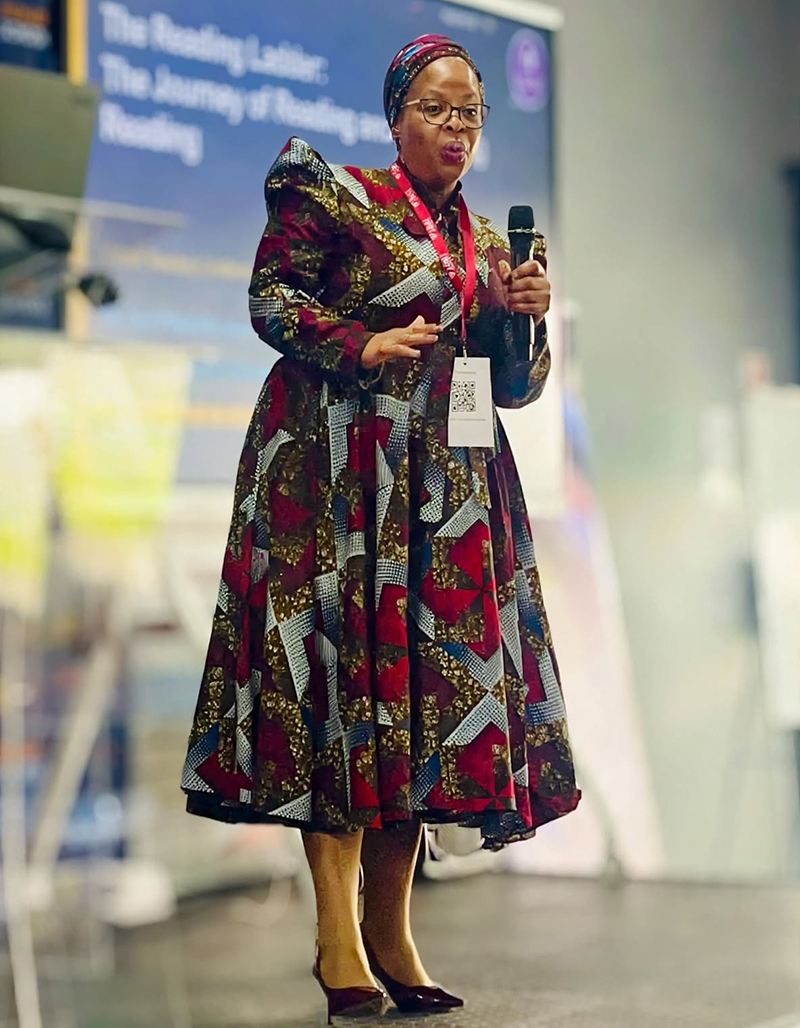
Photo: Nomsa Kubheka-Mohosho addresses teachers at the 4th Primary Schools Reading Conference.


