
Journalism students at the North-West University (NWU) had the opportunity to engage directly with an experienced newsroom practitioner when senior journalist and sports and deputy editor of the Mafikeng Mail, Teboho Letselela, delivered a guest lecture to Introduction to Journalism students on Thursday, 20 August 2026.
The session formed part of the students’ preparation for their upcoming group assignments, which require them to pitch and produce a hard news article.
Teboho shared practical insights from his career, helping students connect the newsroom concepts they have been learning in class with the realities of professional journalism.
His presentation focused on four key areas: developing and pitching a hard news story, identifying relevant story topics and credible sources, structuring and writing a hard news article and learning from practical examples of stories he has reported and written.
From the classroom to the newsroom
Teboho encouraged students to approach journalism with curiosity, discipline and a strong commitment to accuracy.
He explained that developing a good hard news story begins with identifying an issue that is relevant, timely and of interest to the public. Journalists must then establish what makes the story newsworthy, identify credible sources and gather sufficient information before developing the story pitch.
He also emphasised the importance of verifying information and testing claims against facts before publication.
“A good journalist gathers information, investigates newsworthy topics and presents developing news stories on print publications, online news sources and televised news programmes or on radio shows. So, it is important for journalists to collect information from reliable sources to avoid litigation. A journalist should always have reliable sources, stay informed and research any story they are working on. What is also important is to always test the truth against facts so that they can report objectively,” said Teboho.
His advice comes at an important stage in the students’ academic journey, as they prepare to put their newsroom knowledge into practice through their upcoming assignments.
Journalism as a calling
Reflecting on his own career, Teboho described journalism as both a “calling” and a “prophecy”, highlighting the responsibility journalists have to serve as watchdogs of society.
He explained that journalism as a calling can involve journalists going beyond conventional reporting to undertake in-depth and investigative work, sometimes involving stories that carry significant personal risks. At the same time, he said journalism also requires professionals to consistently and sufficiently report on matters of public interest.
For the students, the session offered an opportunity to understand that journalism extends beyond simply writing stories. It involves research, interviews, verification, judgement, ethical decision-making and a responsibility to the public.
Learning from an accomplished newsroom professional
Teboho has established himself as a prominent journalist in the North West media landscape, with experience spanning breaking news, investigative journalism and sports reporting.
He is also a multi-award-winning journalist. His accolades include Sports Journalist of the Year at the Super Master League Awards in 2018 and 2021, Journalist and Photographer of the Year at the North West Sports Awards in 2019, a nomination for Journalist of the Year at the North West Media Awards in 2021, and Journalist of the Year at the North West Sports Awards in 2023.
He was also a judge for the South African Music Awards (SAMAs) and received a Commendation Award at the Vodacom Journalist of the Year Awards in 2025.
His experience in community journalism has contributed to the recognition of the Mafikeng Mail, which received the Community Newspaper of the Year award at the North West Media Awards in 2022.
Teboho's work has included stories that have attracted attention beyond the local community, with publications such as Mail & Guardian previously referencing his articles as sources.
Connecting students with industry
The guest lecture forms part of the broader commitment of the university to exposing students to professionals and practitioners who can complement their academic learning with real-world experience.
For journalism students in particular, interaction with working journalists provides insight into the pace, pressures and professional standards of the newsroom while allowing students to ask practical questions about the profession.
Reflecting on the invitation, Teboho expressed his appreciation for the opportunity to contribute to the development of the next generation of journalists.
“It was an honour and privilege for the university to have granted me an opportunity to share my expertise in the field of journalism. It is very important to give students a first-hand experience of engaging with professionals in the field so that they have a better understanding of their profession and careers.”
The engagement also reinforced the importance of credible sources, fact-checking and responsible reporting at a time when journalists operate across multiple platforms and audiences.
For the students, the session provided practical guidance that they can apply directly to their upcoming assignments, from identifying a strong news angle and developing a pitch to conducting interviews, verifying information and producing a well-structured hard news article.
As they prepare to enter the newsroom through their academic assignments and, ultimately, professional careers, the message from Teboho was clear: good journalism begins with good information, rigorous verification and a commitment to the truth.
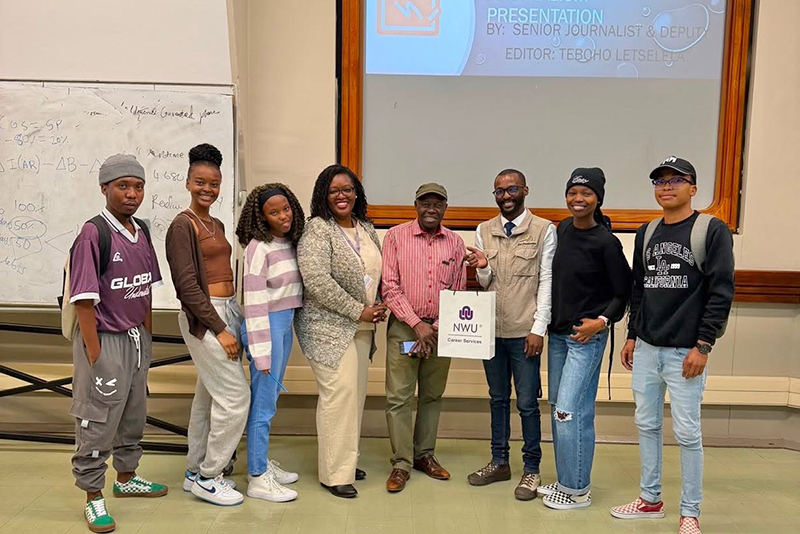
Teboho Letselela, senior journalist and deputy editor of the Mafikeng Mail Bobby Saul, Mafikeng Mail editor, and Dr Adelina Mbinjama, senior lecturer in Communication with some of the students that attended the lecture.


