
The North-West University (NWU) welcomed a high-level delegation from the International Atomic Energy Agency (IAEA) and the Department of Electricity and Energy (DEE) to its Potchefstroom Campus on Wednesday, 1 July 2026, for a strategic engagement aimed at strengthening collaboration in nuclear science, research and human capital development.
The delegation was led by Gashaw Gebeyehu, acting director for Technical Cooperation in Africa at the IAEA, and included Dr Michel Marcel Warnua, IAEA project management officer. They were joined by Lerato Patricia Makgae, chief director and South Africa's National liaison officer from the Department of Electricity and Energy.
The visit formed part of the IAEA Technical Cooperation Programme, which supports member states in building scientific, technical and institutional capacity through the peaceful application of nuclear science and technology.
The day's programme began at the Office of the Vice-Chancellor, where the delegation met with NWU leadership and representatives from the Faculty of Natural and Agricultural Sciences, the Faculty of Engineering, the Faculty of Health Sciences, the Centre for Applied Radiation Science and Technology (CARST) and the NWU Desmond Tutu School of Medicine.
Welcoming the delegation, NWU principal and vice-chancellor Prof. Mzubanzi Bismark Tyobeka said the engagement reflected the importance of international partnerships in advancing research and developing the next generation of scientists, engineers and health professionals.
"Our engagement reaffirmed the strategic value of international cooperation in advancing the peaceful uses of nuclear science and technology," he said.
Discussions focused on radiation protection, nuclear forensics, nuclear energy, nuclear waste management, agricultural applications of nuclear science, as well as research, innovation and education that support South Africa's national priorities.
Prof. Tyobeka said the discussions also reaffirmed the IAEA's commitment to strengthening collaboration with the University through technical cooperation, research partnerships, postgraduate education, curriculum development, fellowships and long-term capacity building.
"A significant outcome of the visit was our commitment to develop a concrete action plan that will guide future collaboration between the IAEA, the Department of Electricity and Energy and the NWU. We also explored the possibility of a formal cooperation framework that will strengthen South Africa's scientific capability and contribute to the peaceful application of nuclear science for the benefit of our country and the African continent," he said.
Following the meeting, the delegation moved to the Faculty of Health Sciences, where they received an overview of the University's participation in the IAEA Technical Cooperation Programme.
The session was chaired by Prof Linda Malan from the Centre of Excellence for Nutrition. Representatives from the Faculty of Health Sciences, the Faculty of Engineering, and the Faculty of Natural and Agricultural Sciences delivered presentations highlighting the University's research expertise, teaching programmes, and IAEA-supported projects.
The delegation also visited several of the University's research facilities, including the Preclinical Drug Development Platform (PhASRec), Eco-Analytica and the Centre of Excellence for Nutrition (CEN). The site visits gave guests an opportunity to experience firsthand the research infrastructure and multidisciplinary work that continue to position the NWU as a leading contributor to South Africa's nuclear science landscape.
Reflecting on the visit, the IAEA delegation praised the University's research environment and collaborative approach.
"We are impressed by the NWU, its research infrastructure and the strong internal coordination across the University," they said. "The presentations were insightful and inspiring, and we look forward to working more closely with the NWU. We are excited to share what we have learned here with our colleagues and to strengthen this partnership in the future."
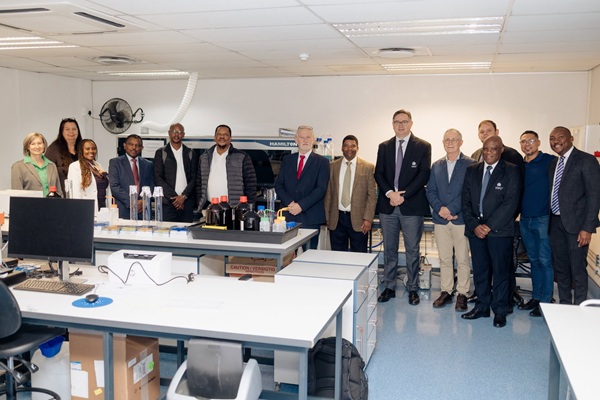
The delegation also visited several of the University's research facilities


