
The Faculty of Humanities at the North-West University (NWU) has concluded another successful Spring School week, bringing together academics, researchers and emerging scholars for a week of intellectual exchange, debate and collaboration.
Held under the theme “Humanising a fractured world: intersections of identity, digital humanities, and geopolitics”, the annual Spring School explored some of the complex challenges facing society and the role of the humanities in making sense of an increasingly divided and rapidly changing world.
The programme featured keynote lectures, panel discussions, round-table conversations, workshops and conference presentations, creating opportunities for scholars from different disciplines to engage with issues ranging from identity and diversity to democracy, technology and geopolitics.
Prof. Mirna Nel, deputy dean for research and innovation in the Faculty of Humanities at the Vanderbijlpark Campus, described the event as a success and highlighted the value of bringing scholars together.
“The Spring School was a great success. It created a space where scholars could come together, share ideas and engage critically with some of the most pressing issues facing our society. The quality of the discussions and the participation from both established and emerging scholars were particularly encouraging,” said Prof. Nel.
A key component of the week was the Undergraduate and Honours Conference, led by Prof. Yolandi Coetser, director of the School of Philosophy and Global Futures. The initiative gave young researchers an opportunity to present their work, receive feedback and learn from more experienced academics.
The importance of developing the next generation of scholars was also reflected in the welcome addresses by Prof. Dumi Moyo, executive dean of the Faculty of Humanities; Prof. Jeffrey Mphahlele, deputy vice-chancellor for research and innovation, community engagement, postgraduate studies with the assigned function of the Vanderbijlpark Campus; and Prof. Linda du Plessis, senior deputy vice-chancellor for teaching and learning.
The speakers emphasised the important role of the humanities in encouraging critical thinking and developing human-centred responses to contemporary challenges.
The Spring School featured a strong line-up of keynote speakers. Dr Neil Barnard of the NWU spoke on “From curiosity to contribution: finding your place in research”, while Dr Doris Viljoen of the Institute for Futures Research at Stellenbosch University presented “Five vignettes from the future”.
Other keynote speakers included Prof. Nicky Falkof of the University of the Witwatersrand, who addressed “Weaponised identity, demonised diversity”; Prof. Anthonie van Nieuwkerk of UNISA, who examined whether the democratic system in South Africa is fit for purpose; and Dr Lizabé Lambrechts of Nuuseum, who explored the challenges and limitations of digital preservation.
Another highlight was the participation of Prof. Bryan Carter, director of the Centre for Digital Humanities at the University of Arizona, who attended with two graduate students. Their contribution brought an international perspective to discussions on digital humanities through workshops and panel engagements.
The programme also placed emphasis on Afrocentric research methodologies and the need for a humanities scholarship to reflect African experiences, knowledge systems and perspectives.
For Prof. Nel, the value of the Spring School extends beyond the week itself.
“Events such as the Spring School remind us that the humanities have an important contribution to make to society. They challenge us to ask difficult questions, listen to different perspectives and think about how research can contribute to more inclusive and humane societies,” she said.
She added that the successful conclusion of the Spring School reaffirmed the commitment of the Faculty of Humanities to interdisciplinary scholarship, meaningful academic dialogue and nurturing emerging researchers.
“Through platforms such as these, the NWU continues to create opportunities for scholars to engage with complex questions while strengthening the role of the humanities in understanding and responding to a rapidly changing world,” she said.
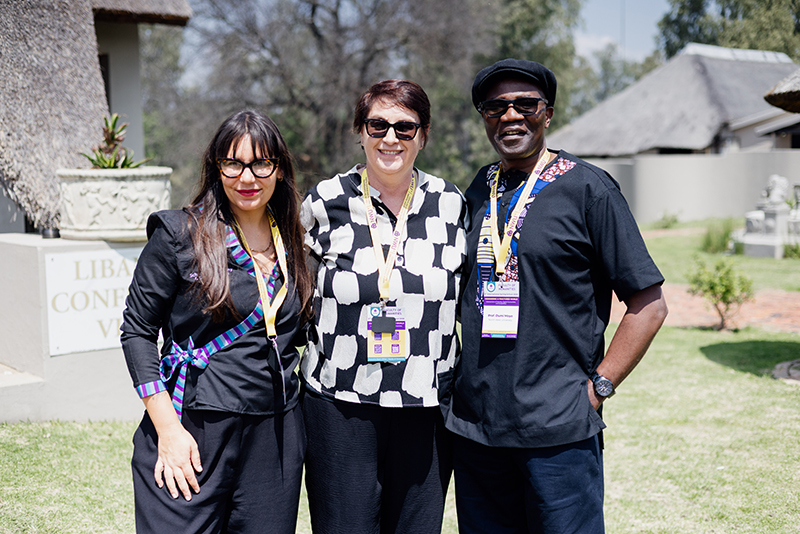
From left are Prof. Yolandi Coetser, director of the School of Philosophy and Global Futures, Prof. Mirna Nel, deputy dean for research and innovation and Prof. Dumi Moyo, executive dean of the Faculty of Humanities.


