
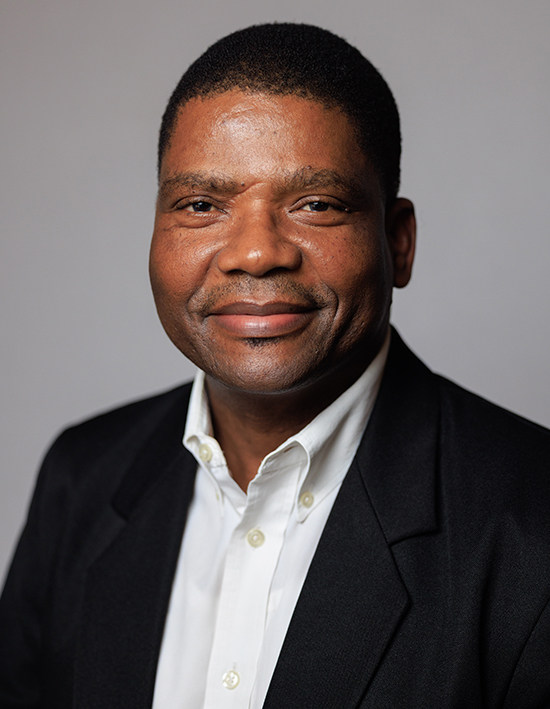
Prof. Jeffrey Mphahlele, Deputy Vice-Chancellor: Research & Innovation, Community Engagement, Postgraduate Studies with assigned function of the Vanderbijlpark Campus
By Prof. Jeffrey Mphahlele, Deputy Vice-Chancellor: Research & Innovation, Community Engagement, Postgraduate Studies with assigned function of the Vanderbijlpark Campus
Apathy should never become our master.
Humanity did not map the world by sitting safely on familiar shores. We raised sails, gripped oars and ventured into the unknown. We traced rivers from their quiet tributaries to the mouths of mighty oceans. We crossed seas guided only by our ingenuity, our courage and the stars overhead. Every generation inherited a world made larger because someone before them dared to ask, "What lies beyond the horizon?"
That age of discovery has not ended. It has simply changed its address.
Today, many of the greatest frontiers lie not beyond distant oceans, but beneath a microscope, inside a laboratory, within a line of computer code, or hidden in a question that nobody has yet thought to ask. There are continents still waiting to be charted in the genomes of microscopic organisms. There are medicines concealed within indigenous plants. There are cleaner technologies, more resilient crops and more sustainable futures waiting to be uncovered. Entire worlds exist beyond the limits of the naked eye.
As a virologist, I have often reflected on the irony that some of the most profound discoveries are invisible. A single microbial cell, unseen by billions of people each day, can illuminate how life functions, how disease spreads, how ecosystems recover and how humanity survives. Curiosity has always demanded that we look closer. The greatest discoveries are often not the largest, but the smallest.
Universities exist to cultivate that curiosity.
The treasures of discovery are not exhausted. They are found every day in the lecture halls, laboratories and field stations of our public universities. They are found in the minds of young researchers willing to challenge assumptions and pursue questions whose answers may take years to emerge. Knowledge remains the most renewable resource humanity has ever possessed. The more we discover, the more there is still to discover.
At the North-West University (NWU), we witness this daily. Researchers are investigating the remarkable medicinal potential of cancer bush and its possible role in future therapies. Others are advancing sophisticated preclinical drug testing that could accelerate medical innovation while improving scientific precision. Our scientists are monitoring antiretroviral compounds in water systems to better understand their environmental impact and protect both ecosystems and public health. These are not isolated academic exercises. They are discoveries with the potential to improve lives, strengthen communities and shape the future.
Yet we pursue this work at a time when knowledge itself seems to have lost some of its public esteem.
We increasingly inhabit a culture where popularity often outranks proficiency, where opinion competes with evidence, where certainty travels faster than understanding. We are tempted to measure influence by applause rather than expertise. Too often we aspire not to become the most informed person in the room, but simply the most liked.
We have become comfortable with abbreviated attention spans instead of lamenting what they quietly replace: patience, rigour and the discipline required to understand a magnificent and wonderfully complex world. Scientific discovery has never rewarded haste. It rewards persistence. It rewards humility. It rewards those prepared to spend years pursuing answers that may ultimately raise even better questions.
Every discovery begins with an act of curiosity. Every breakthrough begins with someone refusing to accept that everything worth knowing has already been known.
The next great discovery may not emerge from an expedition across an ocean. It may emerge from a postgraduate student working late into the night. It may be found in an overlooked microorganism, an indigenous plant, an unexpected pattern in a dataset or a conversation between disciplines that have never spoken before.
The age of greatest discovery is far from over. Its greatest expedition is still ahead of us.


