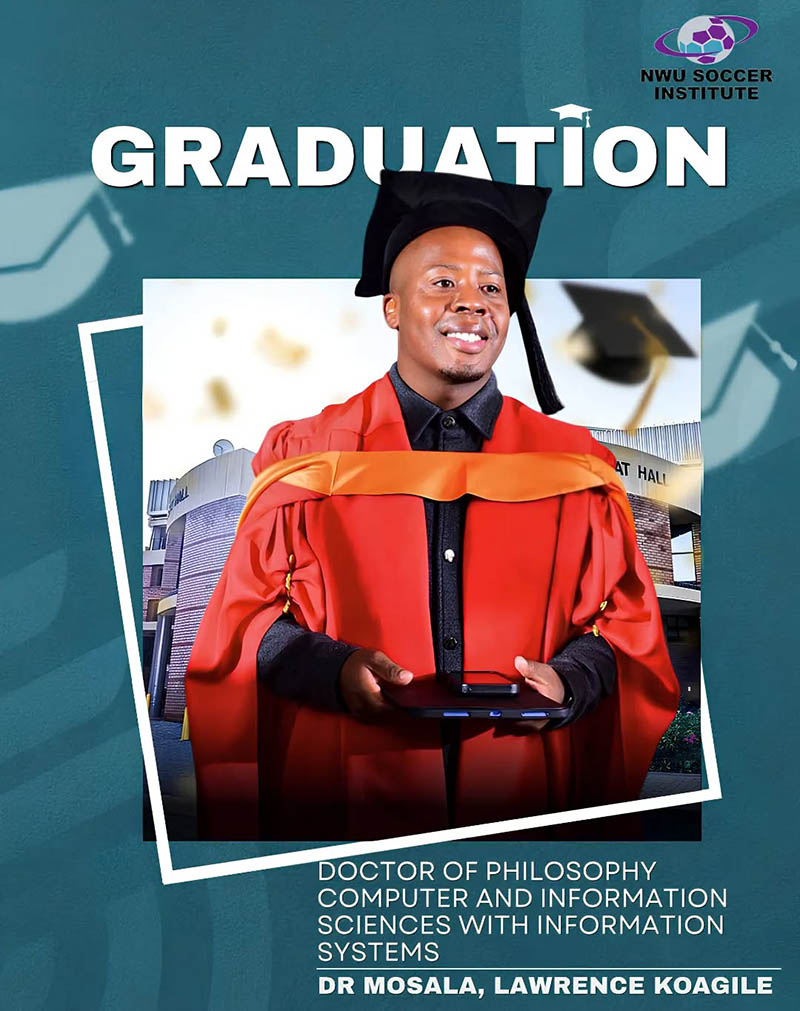
What started on the football field nearly two decades ago has now produced another doctoral graduate for the North-West University (NWU) Soccer Institute. Former player and current team manager Dr Lawrence Koagile Mosala has obtained his PhD in computer and information sciences with information systems.
Dr Mosala is the second former Soccer Institute player to obtain a doctorate after the institute’s manager, Dr Vuyolwethu Sambo, marking another milestone for a programme that continues to position student-athletes for careers beyond football.
The achievement also strengthens the Soccer Institute’s long-standing mission of developing graduates, leaders and professionals alongside competitive football players.
Growing beyond football
Dr Mosala joined the institute in 2007 as one of its founding players and has remained part of its growth over the years. Since 2018, he has served as the institute’s team manager while also working as a lecturer in information systems at the NWU.
His responsibilities as team manager include overseeing team administration, logistics, training coordination, match arrangements and sports equipment management.
Reflecting on the milestone, Dr Mosala says it represents years of balancing football, academics and professional responsibilities.
“The Soccer Institute gave me an opportunity to grow beyond football. Completing this PhD shows that student-athletes can succeed in both sport and academics. I hope this achievement encourages current players to take their studies seriously and prepare for life beyond the game.”
Dr Sambo has congratulated Dr Mosala on the achievement, saying it reflected the values the institute continues to promote among its student-athletes.
“Lawrence’s achievement is important for the Soccer Institute because it shows that our players can excel academically while remaining involved in sport. He has been part of this institute from its early years and continues to contribute as a leader and mentor to current players. We are proud of what he has achieved.”
The NWU Soccer Institute has built a reputation for integrating sport and academic development, with several players graduating while competing in national university competitions.
For the Soccer Institute, Dr Mosala’s achievement serves as another example of how football structures within universities can contribute to academic and professional development.
This comes at a time when universities are under growing pressure to align academic programmes with labour market demands. Clearly, the Soccer Institute and the NWU are staying ahead of the game.