
At a recent Prestige Lecture hosted on the Potchefstroom Campus, researchers, students and the NWU community were challenged to rethink what it means to fight for the environment and the people who depend on it the most.
The Faculty of Law and its National Research Fund (NRF) South African Research Chair in Cities, Law & Environmental Sustainability (SARChi CLES) Research Unit hosted Danjelle Midgely, an attorney, at their 6th Annual Prestige Lecture. Danjelle spoke on “Promoting Environmental Justice: Legal Advocacy and the role of Lawyers beyond the courtroom,” and her lecture was more than a title, it was a call to action.
She set the tone for the lecture by saying “Advocacy is the art of persuasion through communication.”
Environmental Law in South Africa
Danjelle explained the constitutional and legal foundations that make environmental justice possible in South Africa. She explored the relationship between Section 24 of the Constitution and the National Environmental Management Act (NEMA).
While the Constitution guarantees every person the right to an environment that is not harmful to their health and wellbeing, NEMA functions as a framework that supports legislation covering biodiversity, waste management, coastal protection, climate change, and heritage.
“Everyone has the right to an environment that is not harmful to their health and wellbeing,” she stated. “Environmental justice must be pursued so that adverse environmental impact shall not be distributed in a manner that discriminates unfairly against vulnerable and disadvantaged persons.”
For Danjelle, these are living commitments that lawyers, academics, and researchers are required to activate. She further stressed that environmental protection is not only the responsibility of the state, but also of civil society.
Mine blasting and its negative effects on wellbeing
Midgley examined the lived experiences of communities situated near mining operations; people who experience anxiety, fear, and disruption to their wellbeing due to regular blasting activities.
She described how women in these communities have expressed deep fears for the safety of their children, and how healthcare workers reportedly struggle to perform procedures safely during blasts.
“It is important that the voices and demands of communities affected by blasting are centred. This is a key violation not only of environmental rights, but also of our right to wellbeing,” she said.
She argued that communities should share their experiences with government departments through advocacy campaigns, podcasts, medical engagements and public submissions.
Litigation to advance environmental justice
“Litigation is one way to create change through the law, but advocacy provides many creative and innovative tools for advancing environmental justice. By leveraging scientific, academic and technical expertise, as well as media and communication platforms, we can help communities to understand their rights and access remedies without having to go to court,” Danjelle concluded.
The 6th Annual Prestige Lecture reflected the Faculty of Law’s ongoing commitment to linking academic work with real-world impact. Prof Kathleen van der Linde, Executive Dean of the Faculty of Law, welcomed the attendees and emphasised the importance of such lectures in strengthening and improving academic capacity.
Prof Olivier Fuo, Professor of Law at SARChi CLES, expressed confidence in the faculty’s newly appointed leadership team, noting that they would play a key role in steering the faculty towards the NWU’s strategic goal of becoming globally recognised as an institution for its contributions to teaching, research, and community engagement.
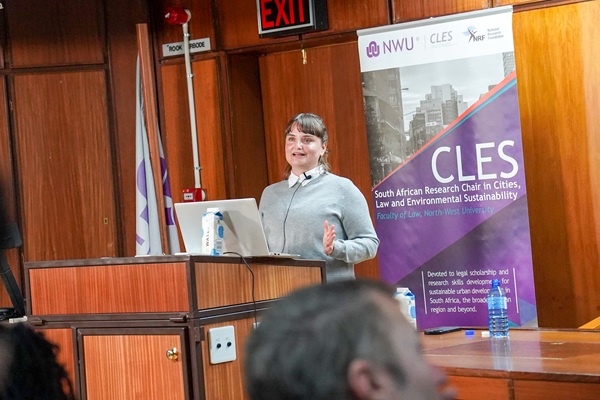
Danjelle Midgeley, an attorney in the Activist Support and Training programme at the Centre for Environmental Rights, delivering her keynote address.
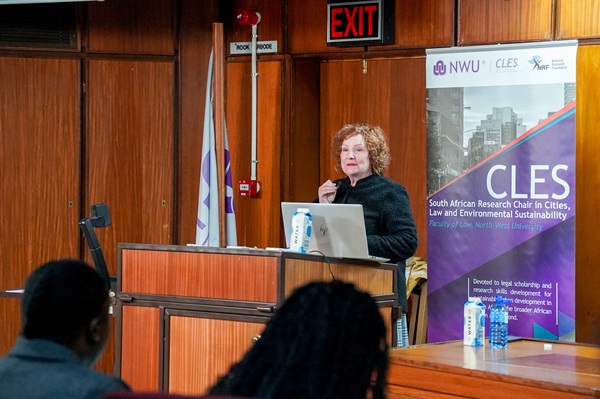 Prof Kathleen van der Linde, Executive Dean of the Faculty of Law, welcomes the attendees.
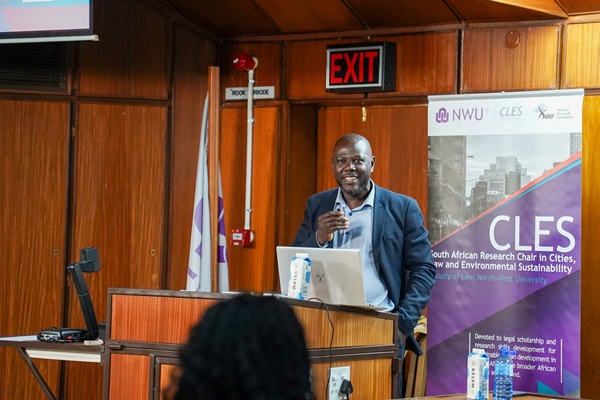 Prof Olivier Fuo, Professor of Law at SARChi CLES, acknowledges Danjelle for being available to travel from Cape Town to deliver this prestige lecture.


