
As artificial intelligence (AI) rapidly reshapes classrooms, careers and the future of work itself, students at the North-West University’s (NWU’s) Vanderbijlpark Campus recently found themselves at the centre of a timely and thought-provoking conversation on the promises, dangers and ethical dilemmas of the AI revolution.
The Faculty of Economic and Management Sciences (FEMS) Student Academic Chapter VPC hosted the NWU AI Chat & Workshop 2026: What Every FEMS Student Needs to Know, bringing together approximately 80 students and university representatives for an engaging and highly interactive exploration of generative AI in academic life.
The workshop unpacked the opportunities, limitations and ethical implications of AI, while equipping students with practical knowledge on how to use emerging technologies responsibly in their studies and future careers.
The initiative was led by the Student Academic Chapter legal officer and organiser, Luzuko Marwanqana, who recognised growing uncertainty among students regarding the responsible use of AI in their studies. “Students were already using AI daily, but many were unsure about where the ethical and academic boundaries were. The workshop created an opportunity for students to receive practical guidance directly from university experts,” said Luzuko.
The event featured presentations from key university experts, including Prof. Liandi van den Berg, director of TELIT-SA, who opened the session with an interactive workshop focused on the future of AI in higher education and the practical ways students can use generative AI to support their learning.
Rather than simply warning students about AI misuse, the session encouraged students to critically engage with AI tools and understand both their value and limitations. Through live demonstrations and guided activities, students explored how AI can assist with brainstorming, structuring ideas, improving understanding, refining grammar and supporting learning processes when used responsibly. Students were also encouraged to think critically about AI-generated outputs, recognise misinformation and bias, and understand the academic integrity risks associated with overreliance on AI tools.
Jan-Paul Viljoen from the Centre for Teaching and Learning provided guidance on the responsible and ethical use of AI in academic work, while Ujeet Maharaj, head of Student Judicial Services, addressed academic integrity, misconduct and the potential consequences of the misuse of AI in assessments.
A guided discussion led by Prof. Van den Berg concluded the formal programme and gave students the opportunity to engage directly with speakers on pressing questions surrounding AI use in higher education.
Feedback from students highlighted the significant impact of the workshop. One student commented: “The workshop made AI feel less confusing and more useful for my studies and how to use it ethically.”
The workshop was made possible through collaboration between TELIT-SA, the Centre for Teaching and Learning, Student Judicial Services and the FEMS Student Academic Chapter VPC, reflecting the continued commitment of the NWU to preparing students for a rapidly evolving digital and AI-driven future.
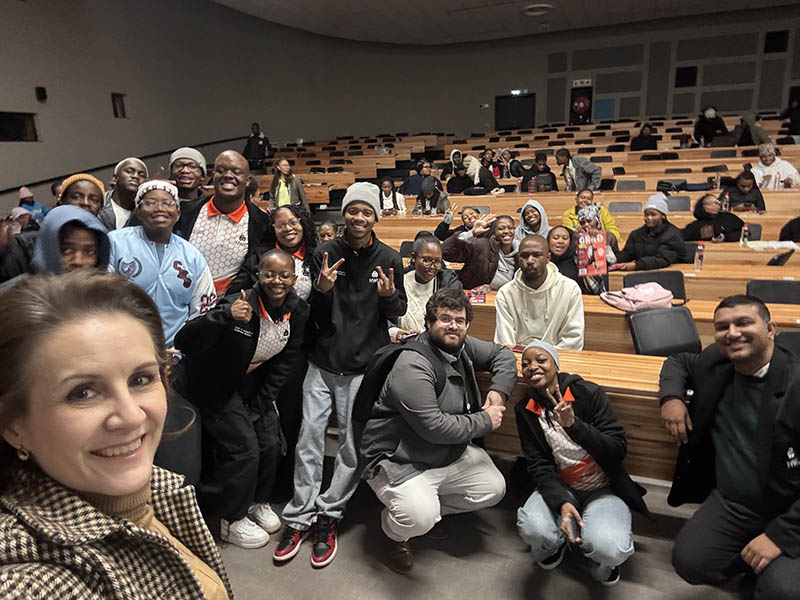
Students from the Faculty of Economic and Management Sciences explored the possibilities and pitfalls of AI during the NWU AI Chat & Workshop.


