
By Prof. Bismark Tyobeka, principal and vice-chancellor of the North-West University (NWU).
I remember Friday evenings in Pennsylvania. I was a young South African studying nuclear engineering at Penn State. My wife and I would go to Red Lobster, and I would sit across from her thinking about home.
I had grown up in a rural community where opportunities were limited. The idea that my life would take me to the United States, and later to Austria, was far removed from the world I knew as a boy.
But I went abroad to learn. At Penn State, I kept asking myself a simple question: what can I take from what I am learning here and bring home to South Africa?
Later, my career took me to Austria. I saw what other countries could build when they invested in knowledge and, just as importantly, retained it.
And I kept thinking about South Africa.
That question remains when I think about South Africa’s proposed new nuclear build. Because 5.2 GW is not only an electricity number. What if it represents something much bigger?
What if a sustained nuclear-build programme could help reinvigorate an engineering sector that has lost skills, experienced people and manufacturing capability? What have we lost? How do we regain it? And how do we make sure we never lose it again?
South Africa once had deep capability around ambitious nuclear engineering. The Pebble Bed Modular Reactor programme showed some of what we were capable of. We had engineers, scientists, technicians and manufacturers who could handle demanding work.
Then much of that broader capability dissipated.
A new nuclear programme gives us a reason to rebuild. Nuclear construction needs civil, mechanical, electrical and nuclear engineers. It needs materials specialists, technicians, welders, artisans, inspectors and manufacturers working to exacting standards.
It creates difficult work – the kind of work on which engineers grow.
A sustained programme also gives companies a reason to invest in people, equipment and quality systems. The first project should prepare us for the second, and the second for the third. That is how capability becomes an industry rather than a once-off project.
South Africa already manufactures major electrical equipment, including large power transformers. At Koeberg, South African teams and their partners have undertaken highly complex nuclear work, including replacing enormous steam generators. It reminds us that South Africans can do difficult things.
But 5.2 GW should make us think beyond the electricity leaving a power station.
It means civil works, steel, concrete and piping. It means control and instrumentation systems, electrical equipment, precision manufacturing, specialised welding, inspection, testing and certification. It means engineers, technicians and artisans gaining experience on demanding projects.
Five point two gigawatts sounds like electricity. In reality, it is also a measure of industrial capability.
But none of this is automatic.
We could build 5.2 GW and import much of the technology, equipment and expertise. If nuclear construction is to rebuild South African engineering, localisation, skills transfer, supplier development and industrial capacity must be deliberately built into the programme. Success should be measured not only in megawatts delivered, but in what South African companies can do afterwards that they could not do before.
Data centres and other energy-intensive industries need large quantities of dependable power. Nuclear can form part of that answer. But I want us to think beyond the electricity leaving a power station to the engineering capability created while we build it.
For me, it is personal. For South Africa, it is imperative.
I went to Penn State and later to Austria because I needed to learn. We cannot accept that leaving the country must always be the route to the highest levels of knowledge.
The expertise is also here, although sometimes scattered. Some who carry it are ageing. Others have left the industries in which they developed it. We need to find that knowledge, retain it and pass it on.
Let experienced engineers teach. Let technicians pass on what cannot be learnt from a textbook. Give young engineers real projects on which to practise their craft.
Standards matter too. In my work with the South African Bureau of Standards, I ask: can our companies meet the standards required to participate credibly in a nuclear supply chain? Can “made in South Africa” sit on components used in demanding nuclear projects?
I believe it can.
But capability does not appear because we wish for it. We have to build towards it.
Corruption, misappropriation of funds, weak oversight, stop-start policy and a lack of long-term vision can hollow out a programme before its industrial benefits are realised.
Nuclear requires continuity measured in decades. If we rebuild capability and allow it to disappear again, we will have failed twice.
These days, I walk on the treadmill in the mornings. It gives me time to think. My mind sometimes goes back to Pennsylvania, those Friday evenings with my wife, and Austria.
As a young man, I asked what I could bring home. Now I ask: what have I brought home, and what can we do with it?
I return to the same thought: we know more than we sometimes realise. The challenge now is to use it.
I want South Africa to be a country that builds, not merely buys. A country that teaches, not only learns. A country that leads, rather than follows.
That is what a well-designed nuclear-build programme could help us become.
My hope is that we rebuild our engineering and manufacturing capacity so fully that the journey I took as a young man no longer has to be the journey of the next generation.
I do not want young South African engineers sitting in a foreign country asking what they can bring back.
I want them here, surrounded by world-class capability, asking a different question:
What can we build here that we can take to the world?
We need to rebuild it. We need to retain it.
And we cannot allow ourselves to lose it again.
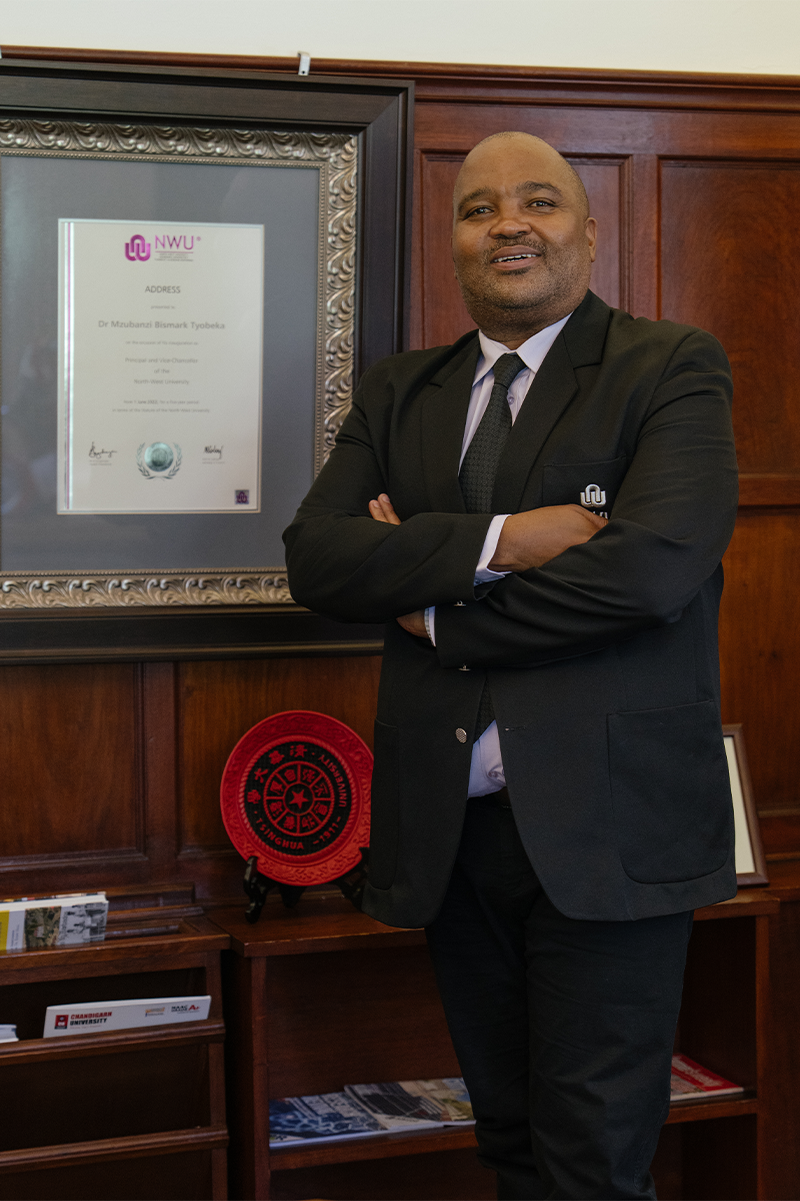
Photo: Prof. Bismark Tyobeka.


