
Effective communication is essential for strengthening democracy, fostering trust and empowering communities. These are among the key findings by newly graduated Dr Jack Malatji, whose doctoral research at the North-West University (NWU) proposes a communication framework to strengthen relationships between Chapter 9 institutions in South Africa and civil society organisations.
Dr Malatji graduated with a PhD in communication after successfully completing his study titled “A communication framework for Chapter 9 institutions to contribute to relationship building with civil society organisations towards mutual empowerment”.
His research addresses a critical challenge facing the constitutional democracy in South Africa. While Chapter 9 institutions are constitutionally mandated to safeguard democracy, promote constitutional rights and protect citizens, they often face difficulties in effectively engaging with communities. According to Dr Malatji, stronger relationships with civil society organisations can significantly improve the ability of both sectors to fulfil their respective mandates.
“Communication is not simply about sharing information. It is about creating meaningful dialogue, building trust and establishing long-term partnerships that empower all stakeholders,” explains Dr Malatji.
His study highlights that Chapter 9 institutions and civil society organisations share a common objective of protecting constitutional democracy and advancing social justice. However, despite these shared goals, structured communication mechanisms to support collaboration remain limited.
To address this gap, Dr Malatji developed a practical communication framework that promotes stronger relationships based on transparency, participation, collaboration and mutual understanding.
The study draws on two complementary communication traditions to develop the framework. The cybernetic tradition provides insight into how organisations can manage communication systems to strengthen relationships, while the critical tradition emphasises dialogue, participation and social change. By integrating these perspectives, the research presents communication as a strategic and transformative tool for relationship building and mutual empowerment.
The qualitative study combined an extensive literature review with semi-structured interviews involving communication specialists from three Chapter 9 institutions: the South African Human Rights Commission, the Public Protector South Africa and the Commission for Gender Equality. Directors from nine civil society organisations working in the areas of human rights, gender equality and justice also participated in the research.
The findings revealed broad agreement among participants that stronger collaboration between Chapter 9 institutions and civil society organisations is both necessary and achievable. Participants acknowledged that although partnerships exist, they are often constrained by inconsistent communication, limited engagement structures and insufficient opportunities for sustained dialogue.
Drawing on both theoretical perspectives and practitioner insights, Dr Malatji refined and validated a communication framework designed to guide long-term, positive and mutually beneficial partnerships. The framework emphasises critical dialogue, transparency, participation, affirmed mutuality, collaboration and respect for cultural diversity as key principles for strengthening relationships and achieving mutual empowerment.
Beyond its practical application, the research makes an important academic contribution by integrating concepts from corporate communication and development communication into a single framework for relationship building. The study demonstrates how communication can move beyond information sharing to become a catalyst for transformative change, solidarity and democratic participation.
Dr Malatji believes the framework has applications beyond Chapter 9 institutions and civil society organisations.
“The framework provides practical guidance for any organisation seeking to build sustainable partnerships based on trust, dialogue and shared purpose. Ultimately, communication should enable organisations to work together more effectively in serving society,” he says.
The research reinforces the important role communication plays in strengthening democratic institutions and creating meaningful engagement between organisations and the communities they serve. By positioning communication as a driver of collaboration and empowerment, Dr Malatji's study offers both a valuable academic contribution and a practical roadmap for organisations committed to advancing constitutional democracy in South Africa.
His achievement also reflects the commitment of the NWU to producing research that addresses societal challenges while contributing innovative solutions with the potential to influence policy, practice and governance at both national and international levels.
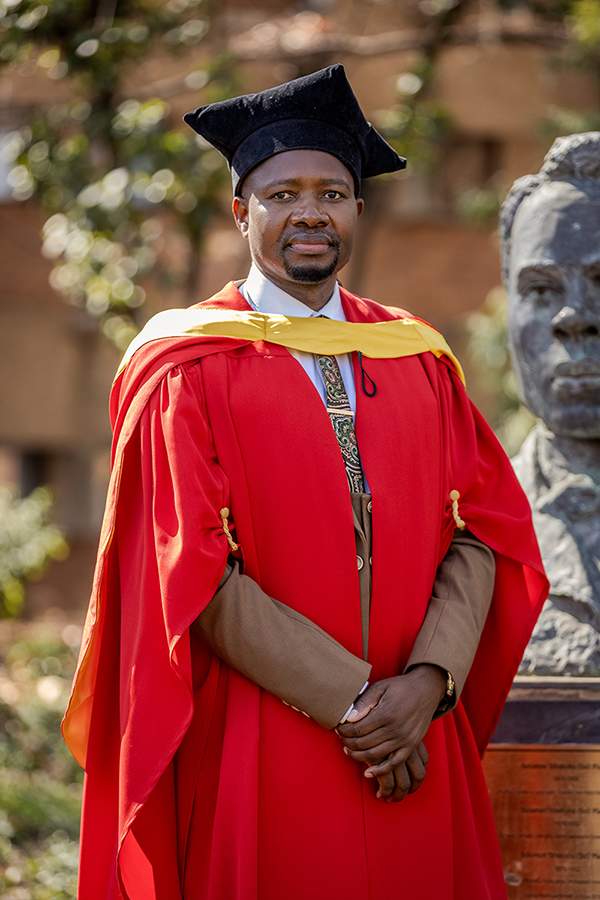
Dr Jack Malatji


