
In 2001, the North-West University (NWU) established and launched a teaching, learning and research programme in Indigenous Knowledge Systems (IKS) at its Mahikeng Campus that was accredited by the South African Qualifications Authority (SAQA).
In 2009, discussions and planning commenced between the NWU, the National Indigenous Knowledge Systems Office in the Department of Science, Technology and Innovation (DSTI), the SAQA, holders of indigenous knowledge, practitioners and other stakeholders to review the curriculum with a view to expanding its scope.
The curriculum for the new Bachelor of Indigenous Knowledge Systems (BIKS) was approved by SAQA, the Council on Higher Education and the Institutional Committee on Academic Standards of the NWU for implementation in 2012.
The new BIKS programme was launched in 2013 and is currently offered in the Faculty of Natural and Agricultural Sciences at the Mahikeng Campus of the NWU. The BIKS is a multi- and interdisciplinary qualification that is designed to enable students to acquire the necessary knowledge, skills, attitudes and values in IKS, and it is also currently being assessed through the programme qualification mix review. More than 90 BIKS students will graduate at the 2026 graduation ceremony. The BIKS was first launched at the NWU, and then the University of Venda followed.
Over the years the NWU has been part of the consortium constituted by historically disadvantaged institutions, which includes the University of Venda, the University of Limpopo, the UNISA and the University of KwaZulu-Natal.
Since its inception, the Centre of Indigenous Knowledge Systems (CIKS) has had the long-term visionary goal of research, science and community engagement to position itself as a national, regional, continental and global rallying hub for the preservation, promotion and protection of IKS through multi- and transdisciplinary collaboration among researchers, institutions, community knowledge holders and practitioners in and outside South Africa.
The announcement that the National Research Foundation (NRF) had accepted and acknowledged that the CIKS needs to be upgraded to a fully-fledged centre of excellence was welcome news at the DSTI NRF strategic workshop on the future of the CIKS that took place in October 2024.
In 2018 the NRF had conducted a midterm review of the CIKS. The evaluation was aimed at assessing the performance of the centre in its first five years and providing a basis for future decisions by the DSTI and NRF. The impact of the centre on the National System of Innovation and on South Africa was a key consideration for decision-making.
The establishment of the centres of excellence was a response to the South African National Research and Development Strategy of 2002, which emphasised the importance of the creation of centres and networks of excellence in science and technology, including the social sciences, as a key component of the human capital and transformation dimensions of government policy.
In 2025, the CIKS initiated processes to establish the African Institute in Indigenous Knowledge Systems (AIIKS). On 28 November 2025, the Science Diplomacy Award was presented to the AIIKS at the CSIR International Convention Centre, Pretoria. Members of the Centre of Excellence in Indigenous Knowledge Systems (CEIKS), including Dr Motheo Koitsiwe (NWU); Dr Chinsamy (UKZN); Dr Monnica Bhuda (University of Mpumalanga); Dr Mlungisi Cele (director-general from the DSTI); Prof. Yonah Seleti (chair of the steering committee); Kedi Aphane (deputy director, Knowledge Management Systems, DSTI) and Thelma Molokwa (IKS PhD candidate, NWU), attended the event to receive the award. Receiving this award affirms the growing recognition of indigenous knowledge as a vital knowledge system and highlights the role of the AIIKS in decolonising research, innovation and knowledge production in Africa.
Moreover, UNESCO has formally partnered with the AIIKS to position it as a UNESCO‑affiliated continental hub for African indigenous knowledge systems. This partnership is being structured through the Category 2 Centre mechanism of UNESCO, which links specialised institutes to UNESCO’s global programmes while they remain legally and financially independent.
For more information: https://aiiks.org/
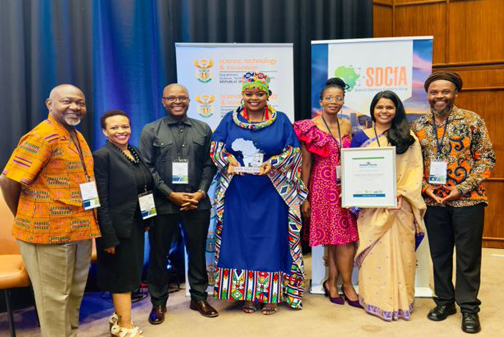
Members of the Centre of Excellence in Indigenous Knowledge Systems (CEIKS) receive the Science Diplomacy Award.


