
More than a hundred researchers, policymakers and academics came together in Mauritius for the 11th Social Sciences International Research Conference (SSIRC), held from 8 to 11 September 2026.
An important message throughout the four-day conference was that the social sciences are no longer on the sidelines. They play a central role in understanding and addressing some of the world’s biggest challenges. The conference also highlighted the value of research, open discussion and new ideas in finding practical solutions.
A pre-conference workshop on 8 September, hosted by the World Trade Organisation Chair programme at the University of Mauritius, got SSIRC 2026 underway. The sessions covered tools for identifying trade opportunities, academic publishing, and trade and investment modelling, giving delegates, particularly early-career researchers, practical skills and setting the tone for the conference.
The main conference began on 9 September at the Hilton Resort and Spa with a welcome ceremony chaired by Prof. Ephrem Redda, research professor at the North-West University’s (NWU’s) WorkWell research unit and chair of the SSIRC.
Prof. Mabutho Sibanda, executive dean of the Faculty of Economic and Management Sciences at the NWU, and Prof. Kavi Kumar Khedo, vice-chancellor of the University of Mauritius, welcomed delegates and highlighted the importance of collaboration between African institutions in advancing global research.
Prof. Redda set the tone for the conference, encouraging delegates to think beyond the usual. “Let us make these next few days more than simply a conference. Let us make them a space where ideas connect, collaborations take root, and research moves beyond discussion to create meaningful impact.”
Two keynote speeches followed. Dr Priscilla Muthoora Thakoor, governor of the Bank of Mauritius, shared insights into the economic realities facing small island economies and Dr Kaviraj Sharma Sukon, minister of Tertiary Education, Science and Research, spoke about the government’s role in evidence-based policymaking.
Thursday’s plenary session featured Prof. Sibanda, whose keynote address, “Fiscal Sustainability, Governance, and the Informal Economy: Financing Universal Health Coverage in Sub-Saharan Africa”, tackled one of the continent’s biggest challenges.
With informal economies making up a large share of gross domestic product across the region, Prof. Sibanda argued that traditional tax-funded health financing models are not enough. He called for new governance frameworks that include informal workers in fiscal discussions, linking economics, public health, and social justice in a way that captured the interdisciplinary spirit of SSIRC.
Over three days, the conference covered themes, including business resilience and sustainability, emerging technology, digital marketing, law, human resources and public sector management. The hybrid format also allowed delegates to join virtually.
Sessions explored how artificial intelligence and digital transformation are changing organisations, how businesses are responding to climate and supply chain challenges, and the growing focus on service excellence in higher education.
The conference concluded on 11 September with a closing ceremony, during which the Best Paper Award was presented to Prof. Ayesha Bevan-Dye by Prof. Crizelle Els, director of the WorkWell research unit of the NWU. The Best Presentation Award was presented to Prof. Shelley Farrington by Prof. Rajesh Sannegadu from the University of Mauritius.
The 11th SSIRC left delegates with a clear message: meaningful research should be interdisciplinary, relevant to policy and accessible. When social scientists come together with a shared purpose, their work can make an impact far beyond academia.
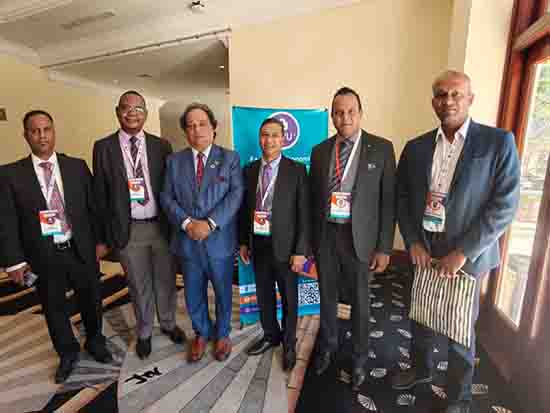
From left are Prof. Ephrem Redda, chair of the SSIRC and research professor at the NWU’s WorkWell research unit, Prof. Mabutho Sibanda, executive dean of the NWU’s Faculty of Economic and Management Sciences (FEMS), Dr Kaviraj Sharma Sukon, minister of Tertiary Education, Science and Research, Mauritius, Prof. Babs Surujlal, former executive dean of the NWU’s FEMS and the founding co-chair of the SSIRC, Prof. Kavi Kumar Khedo, vice-chancellor of the University of Mauritius, and Prof. Boopen Seetanah, dean of the Faculty of Law and Management at the University of Mauritius.
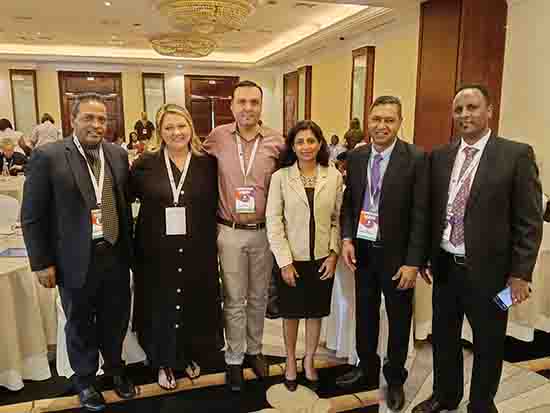
From left are Dr Rajesh Sannegadu from the University of Mauritius, Prof. Crizelle Els, director of the NWU’s WorkWell research unit, Prof. Ankit Katrodia from the WorkWell research unit, Dr Priscilla Mathura Thakoor, governor of the Bank of Mauritius, Prof. Babs Surujlal and Prof. Ephrem Redda.


