
What if the establishment of an NWU School of Mines and Mining Engineering in Rustenburg became the beginning of something much larger?
What if it opened the door to broader access to university education, stronger healthcare training, executive development, thriving local enterprises and lifelong learning across the region?
That is the scale of ambition this opportunity deserves.
By Prof. Bismark Tyobeka, principal and vice-chancellor of the North-West University (NWU).
Introducing a specialised engineering discipline closer to historically disadvantaged communities would be a significant achievement. But its greater promise lies in what could grow around it: a connected university presence through which education, industry, government and communities build lasting regional prosperity.
Mining engineering can be the anchor. The opportunity extends across the regional economy.
From mineral wealth to human capability
For communities living alongside mines, proximity to economic activity does not automatically create access to its professional and commercial opportunities. A young person may grow up surrounded by mining infrastructure without seeing a clear pathway into engineering, scientific research, management or enterprise ownership.
An NWU presence could help change that.
Partnerships with schools, enrichment programmes in mathematics and science, bursaries, mentoring and workplace exposure could make those pathways visible and achievable. Academic and financial support would then help students complete their studies and progress into meaningful careers.
The ambition must extend to women, working adults and young people whose circumstances have placed university education beyond their reach.
A region’s development takes on a different character when its people can design its technologies, lead its institutions and own businesses within its economy.
An opening for health sciences and medical education
The wider opportunity becomes especially compelling when we consider healthcare.
The proposed tertiary hospital in the Bojanala area, involving the Royal Bafokeng Nation and government, offers a potential connection between expanded healthcare provision and university education. In its 2023 budget statement, the provincial health department reported progress on the project’s design and business case, land arrangements with the Royal Bafokeng Nation and continued commitment from mining houses. That provides a foundation on which a renewed partnership could build.
As the hospital project advances, its potential educational role should be considered from the outset.
It could provide a natural platform for extending NWU’s health sciences activities into the area, particularly nursing education and clinical training. With the necessary agreements, staffing, supervision and approvals, it could also expand the clinical training platform available to the NWU Desmond Tutu School of Medicine.
The possibilities extend to rehabilitation, occupational health, mental health, community health and research into the relationship between work, living conditions and wellbeing.
A hospital connected to a university can become a place where care, teaching and research strengthen one another. Students gain supervised experience; practitioners gain opportunities for professional development; and communities benefit from a stronger connection between evidence and care.
Imagine a young person from the region being able to pursue a pathway into nursing or medicine, undertake part of their clinical training locally and build a career serving the communities from which they come.
That is a powerful expression of regional transformation.
Bringing the NWU Business School closer to the regional economy
Rustenburg also presents an opportunity for the NWU Business School to expand its footprint.
Mining companies need capable executives, but the leadership needs of the region extend much further. Contractors, banks, retailers, logistics businesses, hospitality enterprises and professional services firms all depend on sound management.
Municipalities and regional government offices likewise need managers who can turn budgets, policies and plans into reliable services.
Locally accessible executive education could address strategy, financial management, project delivery, procurement, governance, digital transformation and people management. Programmes could use problems drawn from the region itself, allowing participants to apply their learning directly in their workplaces.
Crucially, this opportunity should reach beyond senior executives.
Artisans, technicians, mineworkers, team leaders and other blue-collar employees should have access to development opportunities that support progression into supervisory, management and entrepreneurial roles. Flexible delivery and appropriate entry pathways could help experienced workers translate practical knowledge into broader leadership capability.
A supervisor who learns to manage a team more effectively, a contractor who learns to price work sustainably or a government manager who improves project execution can create benefits far beyond a classroom.
Lifelong learning and a sustainable source of income
The NWU Unit for Continuing Education (UCE) could play a central role in making this vision practical. It already supports continuing education through short courses, short learning programmes, seminars and workshops, with delivery approaches that include online, hybrid and contact learning.
Rustenburg could provide a substantial market for carefully designed offerings developed with employers.
Mining employees could access programmes in safety leadership, maintenance management, environmental responsibility, data literacy and project management. Banking and service-sector employees could benefit from training in financial analysis, customer service, cybersecurity awareness and business development. Government employees could strengthen their capabilities in budgeting, contract management, infrastructure delivery and ethical leadership.
There is also scope to explore quality-assured microcredentials: focused, assessed learning that demonstrates specific capabilities and, where formally designed and recognised, may contribute to further learning pathways.
These offerings must carry clear educational value. Their credibility would rest on sound assessment, relevance to employers and transparent statements about what participants have achieved.
For NWU, this represents an opportunity to generate much-needed third-stream income through contracted training, short learning programmes, applied research and professional services.
That income must be earned through useful, high-quality provision. With proper costing and sustained demand, it could help maintain facilities, support academic capacity and widen access to learning.
The region gains skills; employers gain capability; and the university strengthens its ability to serve.
Building businesses and solving problems together
The School of Mines and Mining Engineering could also become a platform for local enterprise development.
Mining’s value chain creates opportunities in maintenance, engineering design, environmental services, equipment supply, water management, transport and rehabilitation. University expertise could help emerging businesses meet technical standards, improve processes and develop credible products and services.
Research partnerships could bring engineering together with health sciences, computing, business, law and environmental disciplines.
The practical questions are already clear: How can mines operate more safely? How can water be reused more effectively? How can small suppliers become more competitive? How can automation improve productivity while supporting workforce development? How can disturbed land become economically useful again?
These questions connect industrial performance to community wellbeing. They also help prepare the region for economic change, including the eventual contraction or closure of particular operations.
The institution we build today should help Rustenburg develop opportunities that endure through those changes.
An invitation to the companies that shape this region
This vision calls for a coalition of partners with a shared interest in Rustenburg’s future.
Implats, Sibanye-Stillwater, Valterra Platinum, Tharisa, Glencore and Merafe Resources should be part of that conversation.
Their connections to the regional economy are substantial: Implats through its Rustenburg operations, including the incorporated Bafokeng operations; Sibanye-Stillwater through Rustenburg, Kroondal and Marikana; Valterra Platinum through its Rustenburg processing infrastructure; Tharisa through its mine near Rustenburg; and Glencore–Merafe through its regional chrome and smelting asset base.
The invitation extends to the mining value chain. Sandvik and Epiroc, both with a presence in Rustenburg, are natural potential partners in equipment, technology, technical training and applied research. Their expertise could help connect teaching to the systems that graduates and working professionals encounter in practice.
Banks, engineering contractors, transport operators, healthcare providers, technology firms and local businesses should also have a place at the table.
These are invitations to partnership. Each organisation would need to determine its contribution through its own governance processes. But the shared interest is clear: employers stand to benefit from stronger local talent, better management, capable suppliers and a healthier regional economy.
Many contributions and one lasting institution
No single company needs to carry the entire ambition.
A practical partnership could combine contributions of different sizes over several years. A major mining house might support a laboratory, an academic chair or a cohort of bursary recipients. An equipment supplier could provide machinery, simulators, software or technical expertise. A bank could support enterprise development and financial education. Smaller businesses could sponsor individual students, offer placements or contribute specialist services.
Employers could also make a valuable contribution by committing to purchase relevant training for their employees. Such commitments would help establish demand and support sustainable programme delivery.
Modest contributions relative to each partner’s capacity, pooled and sustained, could create something that none could build as effectively alone.
The next step should be a founding partnership forum involving NWU, the Royal Bafokeng Nation, government, municipalities, industry and community representatives. Its task should be concrete: agree on a phased development plan, establish priorities, cost the initial activities and secure commitments linked to measurable outcomes.
Transparent financial oversight, academic independence and public reporting would give partners confidence that their contributions are producing results.
The future is ours to build
A School of Mines and Mining Engineering could be the first doorway into a much broader NWU presence in Rustenburg.
Through that doorway could come aspiring engineers and nurses, future doctors, working adults seeking advancement, entrepreneurs building businesses and public servants determined to improve service delivery.
This is an opportunity to connect mineral wealth to human capability — and to build institutions that continue creating value across generations.
To the mining houses, equipment suppliers, banks, service providers and public institutions of this region: help build the educational capacity on which your own future will depend.
Bring a bursary. Bring a training commitment. Bring equipment, expertise, a research challenge or a funded partnership.
We invite companies, philanthropic foundations, public institutions and individuals to submit partnership proposals, make pledges of support or request further information by emailing miningschool@nwu.ac.za. Contributions, whether financial or in kind, can help turn this shared ambition into a lasting institution.
Let us turn shared interest into shared investment — and build a Rustenburg where the wealth beneath the ground creates opportunity, dignity and prosperity above it.
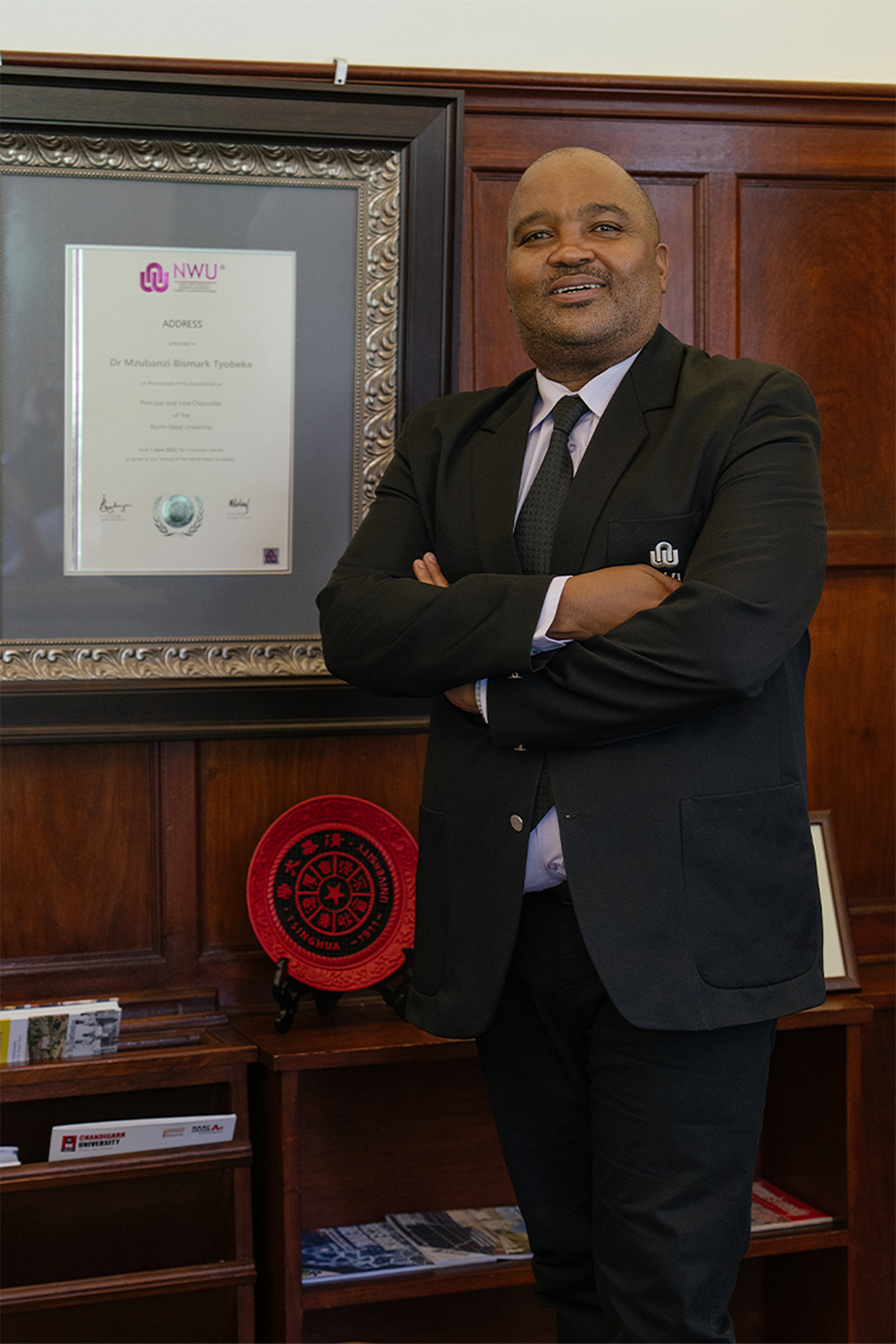
Prof. Bismark Tyobeka


