
By Mzwandile Ndlovu
When North-West University (NWU) senior lecturer Dr Salphinah Vuloyimuni Ubisi reached a new milestone in her career with a publishing award, she was quick to praise her later supervisor.
In December 2025, she was awarded the 2024 Hiddingh-Currie Award at a ceremony hosted by Unisa for her autobiography, Vuloyimuni: How Research on Hostels, Housing and Intergovernmental Relations Took Me to My Roots.
The work is an auto-ethnographic account that blends personal experiences with rigorous analysis, highlighting systemic challenges in governance, the ethical management of government-subsidised houses and the social impact of housing policies.
Dr Ubisi, who is from the subject group Public Administration and Local Government, dedicated the award for her book to the late NWU Prof. Barry Rhulane Hanyane. He supervised her master’s research proposal and played a pivotal role in her academic path.
“Prof. Hanyane laid my research foundation. When I did not have a supervisor for my master’s research study, he volunteered to co-supervise because he strongly believed in me. His exact words were: ‘I observed that this student has potential during her proposal journey’,” she said.
“He may have left us, but his name and deeds will always be remembered. Mitirho ya vulavula, one’s deeds speak,” said Dr Ubisi.
The Hiddingh-Currie Award, presented annually by Unisa Press, is one of South Africa’s most prestigious academic honours. It recognises authors whose work demonstrates profound original scholarship while addressing critical societal needs.
“I am deeply honoured to receive this award. It gives me courage to enhance my knowledge on autoethnography and become a highly skilled autoethnographic author. Vuloyimuni has been a guiding tool in my book project journey, reconnecting me to my roots and shaping the direction of my second book,” said Dr Ubisi.
She emphasised that her auto-ethnography is not just academic but aimed at creating real change in communities struggling with housing shortages. “My biggest hope is to see housing beneficiaries surrender their allocated houses when their socio-economic conditions improve and buy their own houses. The surrendered houses can then assist other applicants on waiting lists. By doing so, more community members in need of houses are supported.”
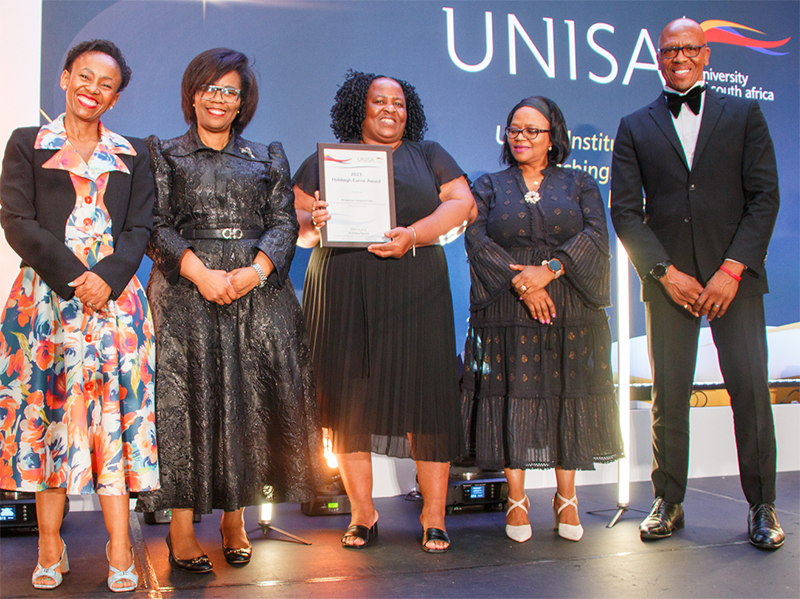
Dr Salphinah Vuloyimuni Ubisi receives the Hiddingh-Currie Award at the Unisa Press awards ceremony.


