
Alumni from the North-West University’s (NWU’s) Centre for Business Mathematics and Informatics (CBMI) recently gathered at The Seven Villa Hotel & Spa in Sandton for an evening of reconnection, reflection and thought-provoking discussions.
Held under the theme “AI in banking: Reshaping customer experience, risk management, and digital innovation”, the event brought together alumni, academics, industry leaders, colleagues and friends of the business mathematics and informatics community.
The event provided an opportunity for alumni to reconnect with former classmates and colleagues, celebrate the enduring relationship between alumni and the NWU, and engage with leading industry experts on the growing influence of artificial intelligence (AI) in the financial services sector.
The programme was directed by Hloni Putsoane, employer engagement specialist at NWU Career Services, while Silvanus Welcome, director for development and fundraising, delivered the welcoming address.
Silvanus described the gathering as an opportunity not only to reconnect with old friends and colleagues, but also to celebrate the lasting relationship between the NWU and its alumni.
“It is my great pleasure to welcome you to this special alumni event,” he said, adding that the success of the CBMI is ultimately reflected in the achievements of the people who have passed through its classrooms and continue to make an impact in business, technology, academia and society.
Silvanus also shared two important developments from the NWU Council.
He announced that the NWU has new Council leadership, with René Kenosi elected as the seventh chairperson of the NWU Council, and Rev. Piet Thlabanyane elected as deputy chairperson.
He further shared that the Council had unanimously approved the reappointment of Prof. Bismark Tyobeka as principal and vice-chancellor of the NWU for a further term. This will be his final term in accordance with the NWU Statute.
According to Silvanus, the decision reflected the confidence of the Council in Prof. Tyobeka’s leadership and its appreciation for the vision and guidance he has provided to the university.
Under his stewardship, the NWU strategy, “Taking the NWU forward: 2024 and beyond”, continues to take shape as the university pursues its ambitions while navigating the opportunities and challenges facing higher education.
However, Silvanus emphasised that the evening was not primarily about governance or institutional announcements, but about the alumni themselves.
“Tonight is about you – our business mathematics and informatics alumni,” he said.
He encouraged alumni to use the occasion not only to reminisce about where they came from, but also to consider what they can build together for the future.
“You remain an important part of the NWU family. Your achievements, expertise, networks and continued connection with the university contribute to the strength and reputation of the CBMI and the NWU.”
Silvanus urged alumni to consider how they can contribute to the university, its students, programmes, graduates and the next generation of business mathematics and informatics alumni.
Prof. Helgard Raubenheimer, director of the CBMI, then shared highlights from the centre.
The session showcased the relevance of business mathematics and informatics and data-driven expertise in addressing contemporary challenges in business and technology, while highlighting the growing importance of analytical, mathematical and technological skills in an increasingly digital economy.
The evening also placed the spotlight firmly on one of the most significant technological developments shaping the financial services sector: AI.
The main panel discussion was facilitated by Prof. Riaan de Jongh, co-founder and former director of the CBMI.
The panel brought together experts from leading organisations in the financial and professional services sectors. It comprised Dr Jacques Venter, head of model methodology at the Absa Group; Leone van’t Zand, chief data and analytics office for conversational AI at FNB; and Monique de Waal, a partner at Deloitte Consulting.
These experts explored how AI is reshaping banking, particularly in the areas of customer experience, risk management and digital innovation.
The discussion provided an opportunity to consider how financial institutions can harness AI and data to improve customer interactions, strengthen risk management, develop innovative digital solutions and respond to the rapidly evolving needs of consumers.
The event also included an update on alumni and Convocation matters, presented by Nicolize van der Walt, section head for alumni relations.
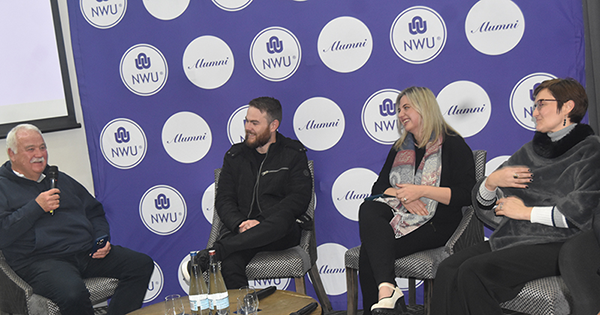
From left are Prof. Riaan de Jongh, co-founder and former director of the CBMI, Dr Jacques Venter, head of model methodology at the Absa Group; Leone van’t Zand, chief data and analytics office for conversational AI at FNB; and Monique de Waal, a partner at Deloitte Consulting.


