
Academics from across Africa and Europe joined colleagues and students from the North-West University (NWU) for a week of teaching, learning, collaboration and cultural exchange - bringing international perspectives directly into NWU classrooms.
From 14 to 18 September 2026, the Faculty of Economic and Management Sciences (FEMS) and the Faculty of Health Sciences (FHS) hosted parallel International Teaching Weeks across NWU’s three campuses.
These weeks formed part of the broader Africa Initiative: International Teaching Weeks, a national collaborative project supported aby the Centre for Teaching and Learning (CTL) at the NWU. The initiative advances internationalisation, professional development, global networking and cultural competence by connecting visiting academics with faculties, lecturers and students in authentic teaching and learning settings.
Two faculty programmes, one shared purpose
The FEMS presented its first African International Teaching Week under the theme “African Footprints: Transforming Teaching and Learning in a Digital Age”, and the FHS hosted its International Teacher Week under the theme “Letsema la tirisano | Harvesting Knowledge Collectively”.
Although each programme reflected its faculty’s disciplines and context, both placed teaching at the centre and created spaces where knowledge, experience and perspectives could be shared across institutional, disciplinary and geographical boundaries.
International perspectives in NWU learning spaces
In the FEMS, eight participants from seven institutions and six countries taught more than 1 500 NWU students across 18 modules and all three campuses, while also engaging with more than 100 staff members. The visiting academics represented institutions in Estonia, Austria, India, Kenya, South Africa and the Netherlands. Their contributions reached five FEMS schools and exposed students to varied disciplinary, institutional and cultural approaches.
In the FHS, participants from Ghana, Sweden, Scotland, Botswana, Belgium and the University of Venda joined NWU colleagues from the School of Psychosocial Health, School of Nursing, School of Human Movement Sciences and Centre for Health Professions Education. Seven partner-led academic engagements recorded 229 attendances. Topics ranged from gender-based violence and trauma-informed social casework to substance abuse, worker health and safety, behavioural interventions, recreation services and interprofessional approaches to suicide prevention.
Feedback from both programmes indicated that students valued this direct international exposure. Almost 500 FEMS students rated the guest lectures an average of 4,62 out of 5; 98% agreed that the lectures enhanced their understanding and offered a valuable learning experience, 96% said the experience broadened their awareness of global perspectives, and 81% expressed interest in more international guest lectures.
Of the 107 FHS respondents, 95,3% said they gained useful knowledge, skills or insights, 93,4% felt that the international perspectives enriched their learning, and 93,5% rated their session four or five out of five.
Learning beyond the lecture hall
The programmes deliberately extended beyond formal teaching. In the FEMS, an interactive workshop led by Prof. Merily Meristo, Prof. Aleksandra Ljalikova and Prof. Liandi van den Berg explored what artificial intelligence means for human development and professional growth. The week concluded with a World Café discussion on future-ready classrooms, the capabilities required by academic staff and students, and the implications of digital transformation, access to technology and higher education policy across diverse contexts.
FHS participants explored teaching and learning in the 21st century, Collaborative Online International Learning (COIL), and ways to work across institutional and disciplinary boundaries. Shared meals, conversations and cultural activities helped relationships develop alongside the academic programme. FHS participants visited Lekwena Wildlife Estate for South African food, cultural activities, music and conversation, while the FEMS programme included a visit to Bona Bona, a bush experience and an interactive drumming session. These informal spaces reinforced a central lesson of the initiative: knowledge is developed not only through presentations, but also through listening, relationships and shared experience.
From a teaching week to sustained collaboration
The relationships established during the week are already opening possibilities for COIL initiatives, future guest teaching, research and sustained collaboration across institutions and disciplines. A Scholarship of Teaching and Learning research project has been initiated by the NWU faculties that hosted International Teaching Weeks in 2026, creating a further opportunity for local and international participants to work together and to build an evidence base for the initiative.
The FEMS programme was organised by Prof. Anneke Moolman, Prof. Esmarie Myburgh, Prof. Ellen Rungani, Prof. Diana Viljoen and Dr Elette Horn. The FHS programme was organised by Prof. Yolande Heymans, Cherelle Abrahams, Dr Cornelia Schreck, Dr Evans Mohlatlole and Dr Christiaan Bekker, with the formal opening delivered by Prof. Alida Herbst, deputy dean for teaching and learning. Working with the faculties, CTL helped connect the programmes to the wider institutional and national collaboration and supported spaces in which colleagues and students could engage, exchange ideas and learn together.
The 2026 International Teaching Weeks were made possible through funding from the Department of Higher Education and Training through the University Capacity Development Programme, with CTL as the leader of the national collaboration with the University of the Western Cape, Nelson Mandela University and the Central University of Technology.
Across both faculties, the week demonstrated how internationalisation can move beyond agreements and travel to become part of students’ everyday learning. Different people brought different expertise and experience; what emerged was knowledge created collectively, new academic relationships and a stronger foundation for future collaboration. The teaching weeks may have ended, but their global perspectives – and the possibilities they created – will continue in NWU classrooms.
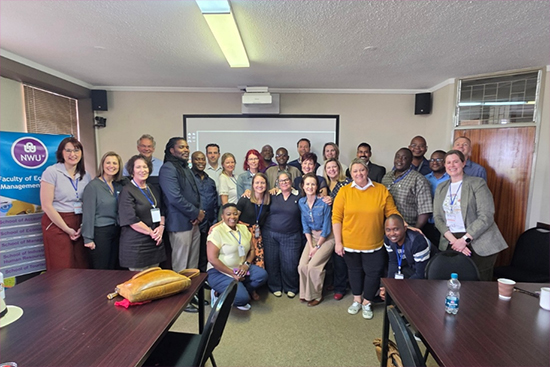
Organisers and international lecturers of the Faculty of Economic and Management Sciences’ International Teaching Week.
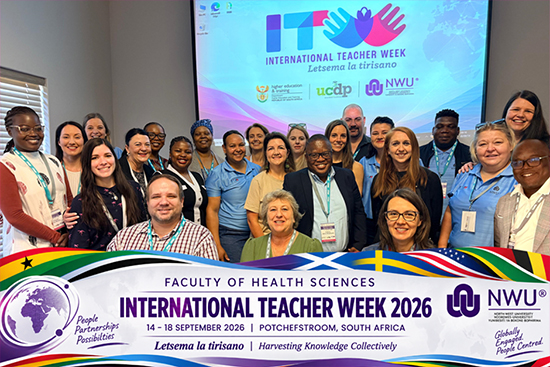
Organisers and international lecturers of the Faculty of Health Sciences’ International Teaching Week.


