
South Africa’s Constitution gives everyone the right to equality before the law. Yet, for many people, accessing justice remains a challenge. Where people live, what they earn and the resources available to them can all influence whether they receive the legal support they need.
These challenges were among the issues explored at the International Access to Justice Conference, hosted from the 11-13 November 2026, by the Department of Justice and Constitutional Development at the Sun City Convention Centre. The conference brought together representatives from government, the judiciary, the legal profession, academia, civil society and international institutions to discuss ways of making justice more accessible.
The gathering also provided an opportunity to reflect on the 30th anniversary of South Africa’s Constitution and the progress made in realising its promise of equality and justice for all.
Among those who attended was Tina Magaqa, a junior lecturer from the North-West University’s (NWU) Faculty of Law. For her, the conference was an opportunity to learn from others, contribute to important discussions and reflect on the role that young scholars can play in shaping the country’s future.
Looking beyond the law
Discussions at the conference covered a range of issues, including policy and international best practice, the use of digital technology in the justice system, victim-centred approaches and the importance of building public trust.
A common thread ran through these discussions: the difference between having rights on paper and being able to exercise them in everyday life.
For people in under-resourced communities, barriers such as poverty, distance and limited access to legal services can make it difficult to seek help. Addressing these challenges requires more than sound legislation. It also calls for effective implementation, cooperation between institutions and a justice system that responds to people's needs.
President Cyril Ramaphosa delivered the keynote address, highlighting the importance of access to justice as a fundamental human right.
For Tina, the subject carries personal meaning. Having grown up in the rural town of Qwa-Qwa, she understands how access to opportunities can change a person's life. Her experiences have shaped her understanding of inequality and the importance of ensuring that people have opportunities, regardless of where they come from.
She believes South Africa must be willing to confront the challenges that continue to affect its communities. This includes acknowledging where systems have failed and taking practical steps to address those shortcomings.
The role of universities
Universities have an important role to play in preparing future legal practitioners. While students need a sound understanding of the law, they also need to understand the responsibility that comes with applying their knowledge and skills in society.
Tina believes academics can help shape this understanding by encouraging a culture of pro bono work and social responsibility. Students should recognise that access to justice is a legal obligation and should not depend on whether someone can afford legal representation.
This also creates opportunities for universities to connect academic knowledge with the challenges people face in their communities. Through research, community engagement and practical learning, institutions can contribute to a more accessible and responsive justice system.
Making room for young voices
The conference also affirmed the value of including young scholars in conversations about the future of justice. Tina believes that being early in one's academic journey should not prevent young people from contributing meaningfully.
“Yes, I am still young, but maybe that means I still have the energy and enthusiasm that is required. Yes, I still need to grow in knowledge and skills, but perhaps that ‘inexperienced’ lens can offer curiosity, an outsider’s perspective and thus, innovation,” she reflected.
For her, opportunities to participate in discussions of this nature are important because they allow emerging academics to learn from experienced professionals while bringing their own perspectives to the table.
Thirty years after the adoption of South Africa’s Constitution, the promise of equal access to justice remains a work in progress. Making that promise a reality requires commitment from government, the legal profession, universities, academics, students and the public.
The conference served as a reminder that access to justice is not only about laws and institutions. It is also about people, their lived experiences and whether they can access the rights the Constitution guarantees.
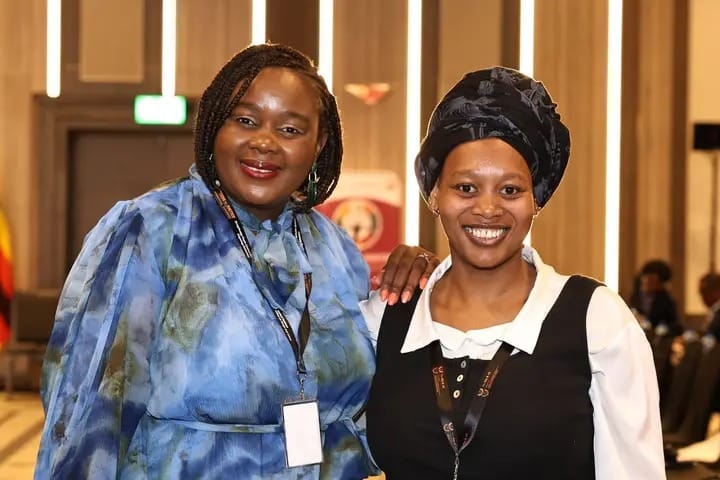
Photo:Tina Magaqa with the Minister of Justice and Constitutional Development during the International Access to Justice Conference at Sun City Convention Centre.


