
Community engagement remains a core pillar of the mission of the North-West University (NWU) to build stronger, more resilient communities. This year’s Community Engagement Showcase supported this mission by aligning with the United Nations Sustainable Development Goals and the African Union’s Agenda for 2063.
Led by the Faculty of Education, the showcase brought students, academics, industry representatives and community partners together at the Tsebonokeng Hall on the Vanderbijlpark Campus. The showcase created a platform for collaboration, engagement and meaningful community impact.
Under the theme, “Empowering communities for sustainable development in Africa: local actions, global impact”, the showcase explored ways in which local action can create lasting change across Africa.
Prof. Jeffrey Mphahlele, deputy vice-chancellor for research and innovation, community engagement, postgraduate studies, with the assigned function of the Vanderbijlpark Campus, said the ultimate goal of the NWU is to promote social justice, greater equity and positive transformation.
In his opening address, Prof. Bismark Tyobeka, principal and vice-chancellor, highlighted the growth of the community engagement portfolio of the NWU. The number of registered projects increased from 406 in 2022 to 605 in 2025.
However, Prof. Tyobeka stressed that growth alone is not enough. “We must be more deliberate about impact, evidence, sustainability and scale. That means we should start identifying interventions that work and strengthen them.
“We must ensure that research and innovation respond to real societal challenges, and develop graduates who understand that their education carries a responsibility to society.”
In his keynote address, Ambassador Aljowaily, director of the Citizens and Diaspora Organisations Directorate of the African Union Commission, said universities can strengthen community engagement by involving civil society in shaping their work.
He said universities should stay close to communities so they can understand their realities. At the same time, they should remain connected to knowledge networks that can help turn those realities into evidence.
Ambassador Aljowaily also said the current generation will shape the future of Africa through its choices and actions.
“The Africa we want begins with the citizens we empower, and a university that empowers its students to serve their communities is already building it.”
Now in its third year, the showcase featured stalls from the faculties at the NWU, including the Business School. Attendees also had the opportunity to explore educational programmes offered by the NWU.
The programme of the showcase also included a roundtable discussion under the theme “Walking alongside one another”. Prof. Louise Bezuidenhout, associate professor of Sustainability, Development and Corporate Communication, Sharon Gordon, managing director at Curro, Malipo Lukandamiza, executive director of African Refugee and Migrants Aid, and Emihle Masite were the speakers. Together they explored the roundtable theme and how collaboration can influence community engagement.
Dr Elize Küng: deputy dean for Strategic Relations on the Vanderbijlpark Campus, introduced Ambassador Aljowaily to the audience.
Lester Mpolokeng, director for Stainability and Community Impact, delivered the closing remarks and a vote of thanks.
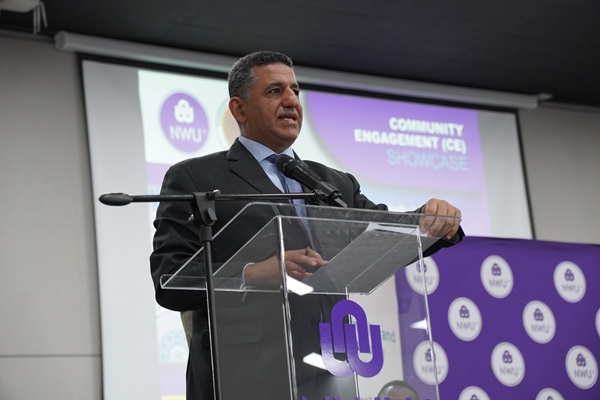
Keynote speaker Ambassador Amir Aljowaily.
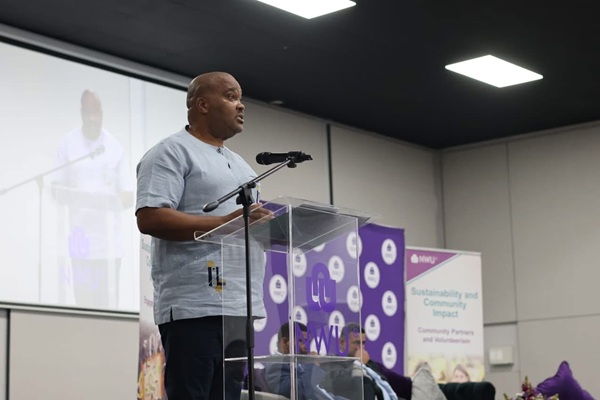
Prof. Tyobeka addresses the audience at the showcase.
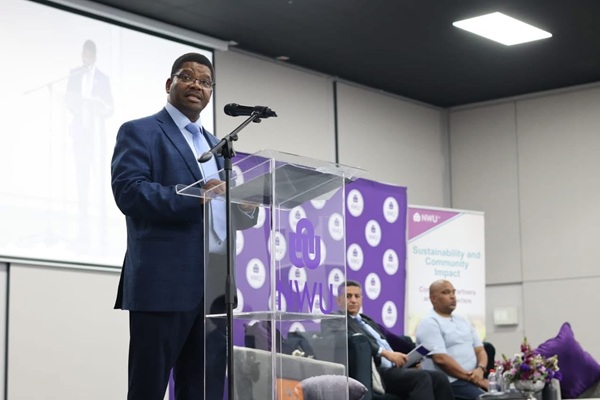
Prof. Jeffrey Mphahlele congratulates the Faculty of Education for organising a successful showcase.


