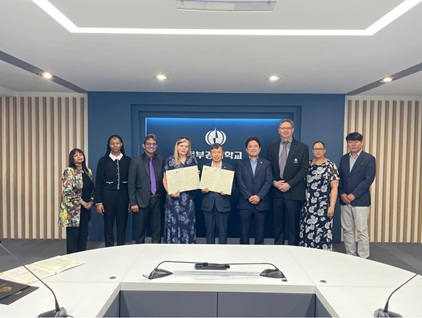
The North-West University (NWU) and Pukyong National University (PKNU) in Busan, South Korea, have signed a memorandum of understanding (MoU) and a student exchange agreement aimed at advancing academic cooperation and international mobility.
The agreements mark a new chapter in the NWU’s internationalisation efforts and strengthen its strategic engagement with the East Asian region.
The respective delegations were led by Dr Myunshin Ha, vice-president of PKNU, and Prof. Linda du Plessis, senior deputy vice-chancellor of the NWU.
The MoU establishes a broad framework for long-term cooperation in teaching and learning, research and academic exchange. PKNU is a leading South Korean university with distinguished colleges in fields including business administration, engineering, fisheries sciences, environmental and marine science and technology, information technology and convergence.
Under the student exchange agreement, the two universities will facilitate reciprocal student mobility. Eligible students will be able to study at the host institution for an agreed period, gaining valuable international academic experience and exposure to another country and culture.
The partnership also creates opportunities for several collaborative initiatives. These include an international dual-degree programme, the PKNU International Summer School Programme, the Korean Language Programme and global language education programmes.
Connecting the blue economy and dryland agriculture
The partnership offers valuable strategic opportunities for the NWU’s Faculty of Natural and Agricultural Sciences. PKNU is internationally recognised for its expertise in marine and fisheries sciences, particularly aquaculture, marine biotechnology, food science, food technology and nutrition.
Although there is limited direct overlap between the institutions’ academic offerings, their complementary strengths create significant possibilities in the broader fields of food security and sustainable food systems.
PKNU’s expertise in aquaculture and marine biotechnology could be combined with the NWU’s strengths in animal science, crop science and agricultural economics. This could support collaborative research into critical areas such as protein security, alternative aquaculture feeds derived from crops and sustainable food value chains.
The partnership therefore creates an exciting “blue economy meets dryland agriculture” opportunity, bridging marine- and land-based food-production systems to address shared global challenges.
The NWU has extended an invitation to a PKNU delegation to visit South Africa and the university’s Mahikeng, Potchefstroom and Vanderbijlpark campuses.